Jenny and David are spending two months in New Zealand in early 2019. Jenny is working (mostly) while David will be cycling plus being tourists. Jenny is working most of the time but this blog mostly reflects their off-duty time! Work blogs can be found at https://nztrip.video.blog/transport-and-health-in-new-zealand/
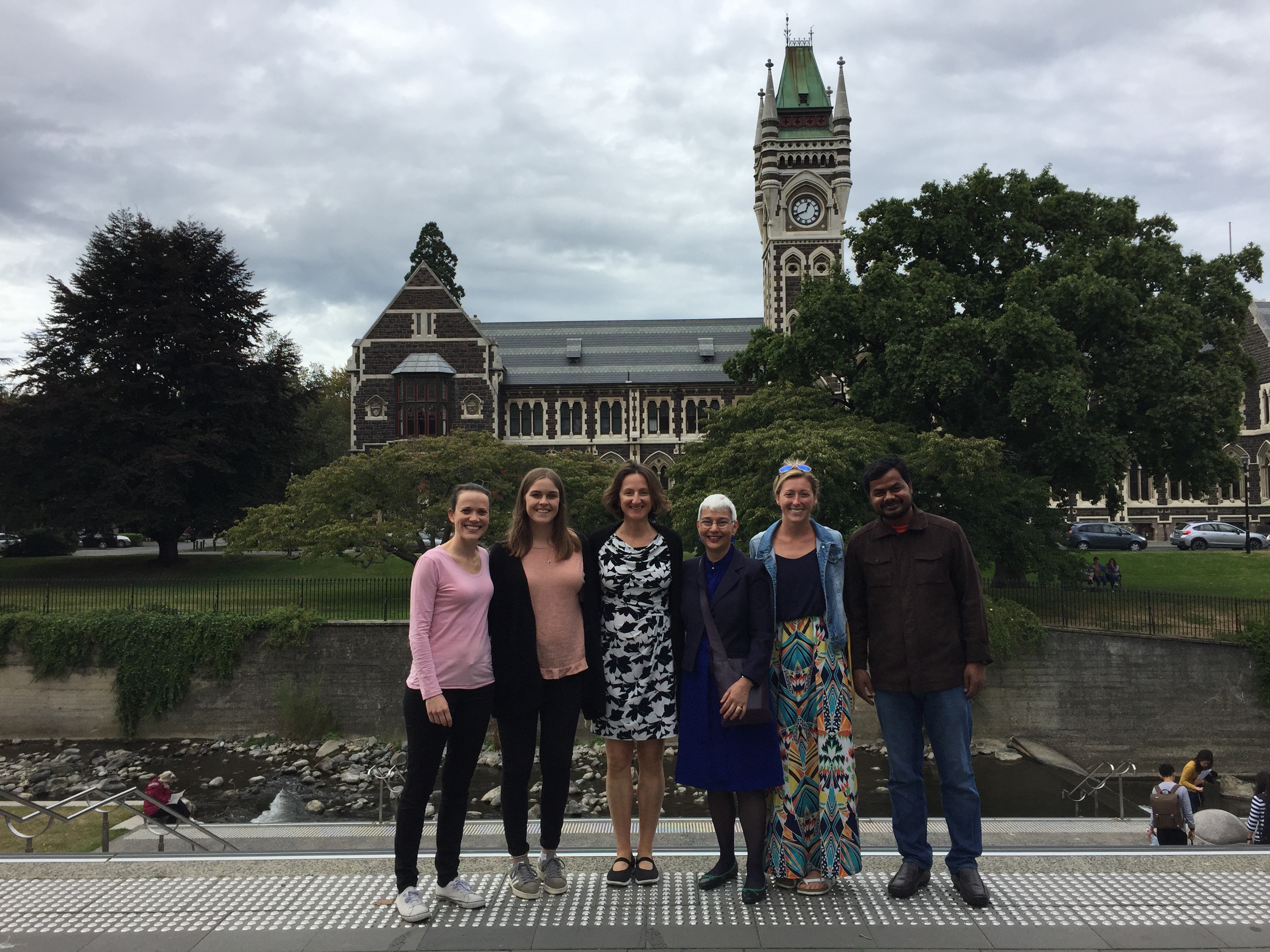
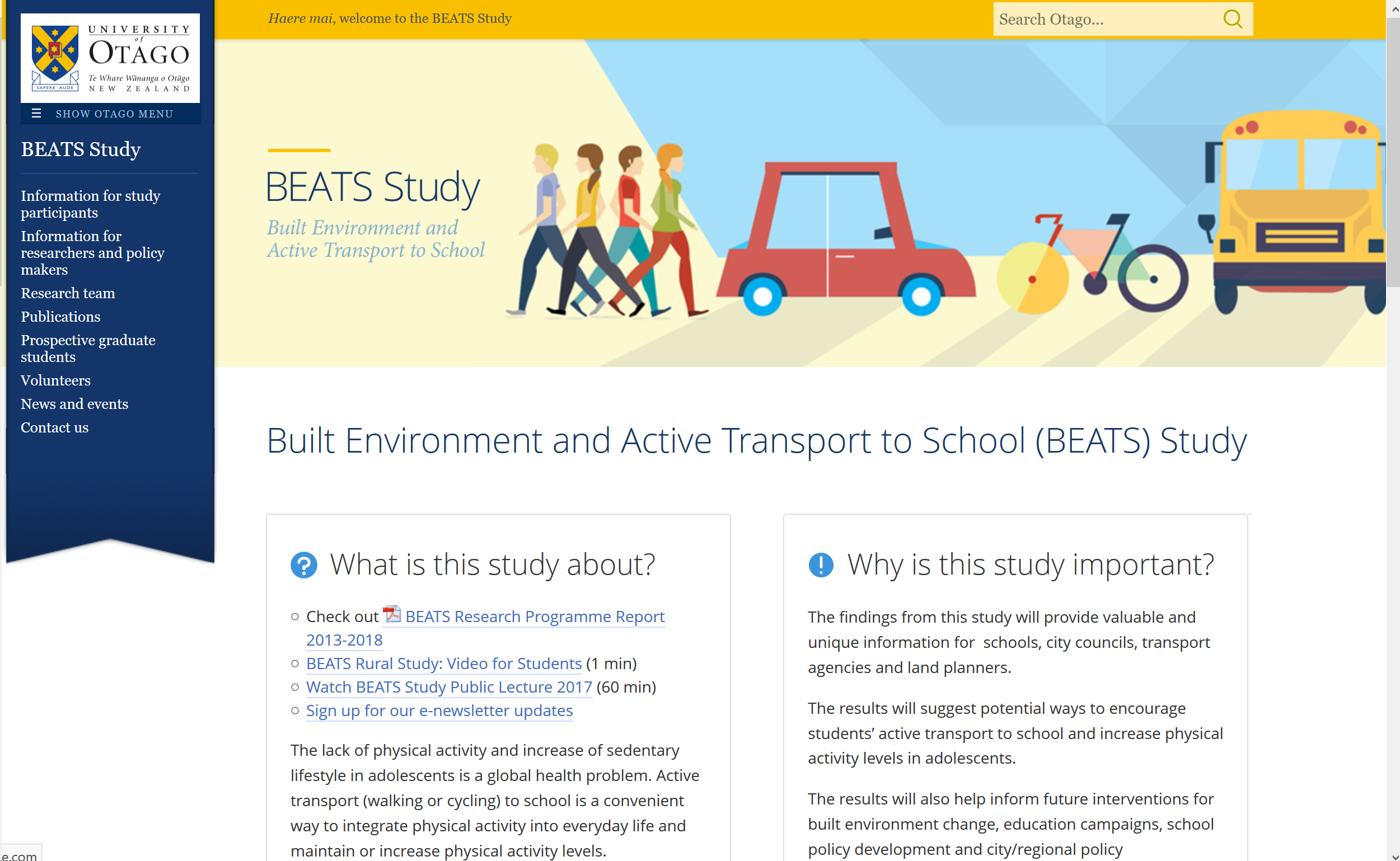
For most of my time in Dunedin, I was hosted by the School of Physical Education, Sport and Exercise Sciences. My host was Associate Professor Sandra Mandic, who focuses on researching active travel by children and adolescents, particularly through the longterm BEATS study https://www.otago.ac.nz/beats/index.html. She managed to recruit 100% of secondary schools in Dunedin and 85% of schools in Central Otago, which is very impressive. The BEATS team includes students and a research administrator in the Active Living Laboratory in the School, together with collaborators from across Dunedin and elsewhere in New Zealand, as well as some international collaborators.
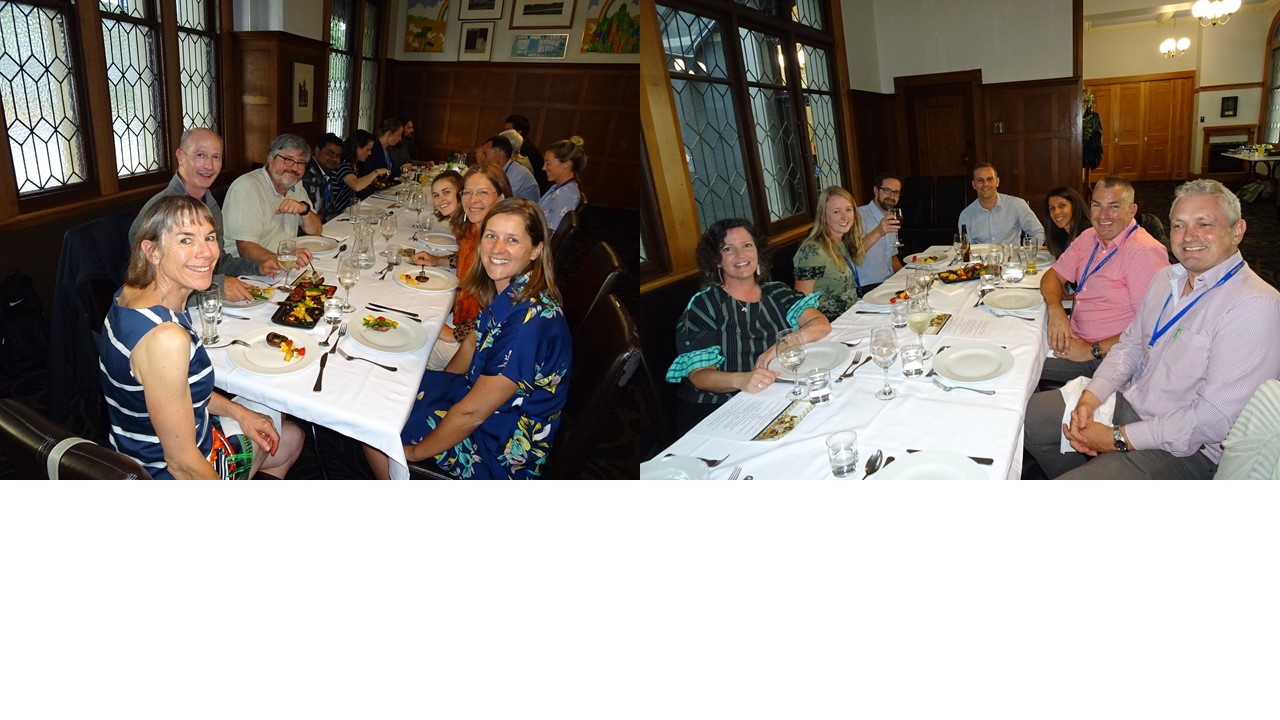
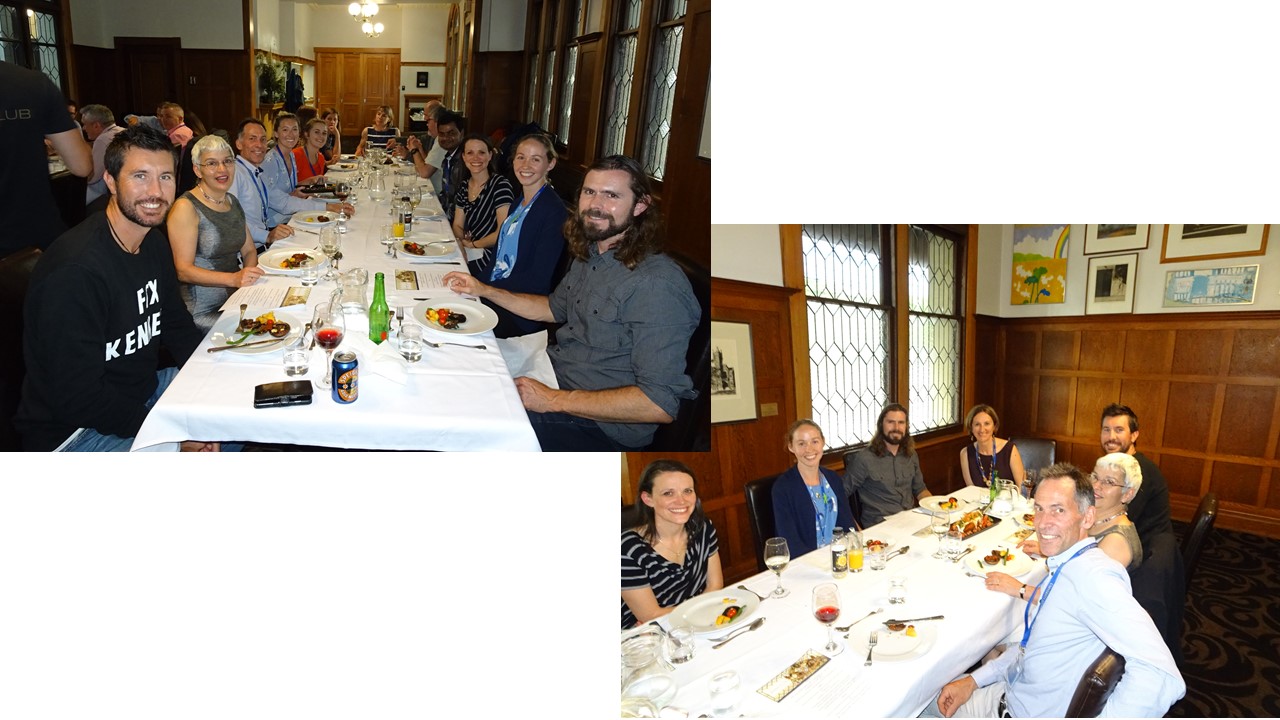
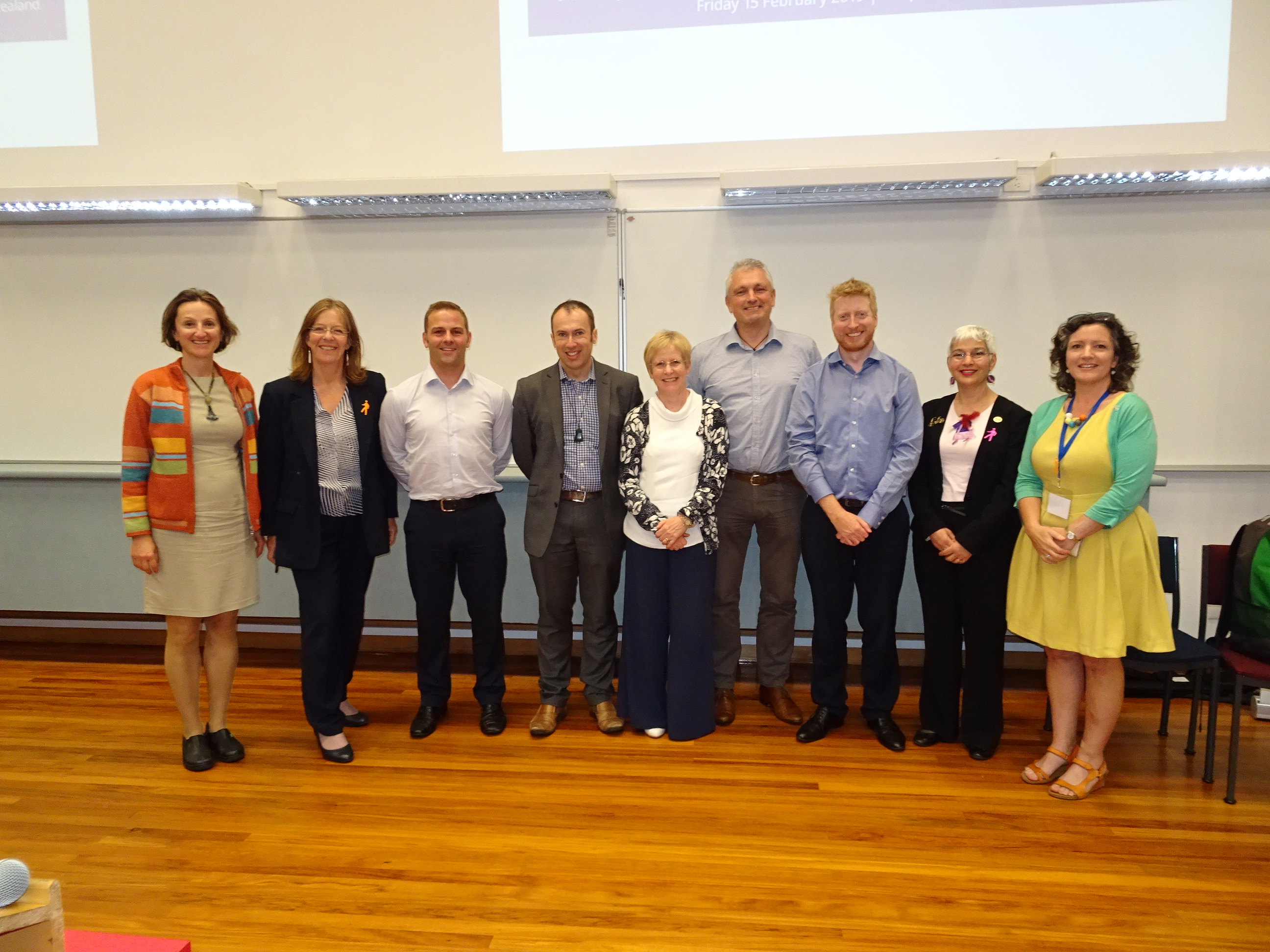
The current Active Living Laboratory team, plus Jenny
With relatively little funding, Sandy has developed the BEATS study to include several spin-off research projects, together with knowledge exchange and implementation work, greatly increasing the value of the study. They have organised biennial BEATS Study Symposia, at which their recent findings are presented to a wider audience, including members of the public. This is in addition to the TALES seminars for academics, policy-makers and practitioners. As a result of my William Evans Fellowship as Visiting Professor, I will be working with the BEATS team to write up some as yet unpublished results.
Another outcome is the plan to have a special issue of the Journal of Transport and Health that focuses on transport and health in New Zealand. Watch out for the call for papers!
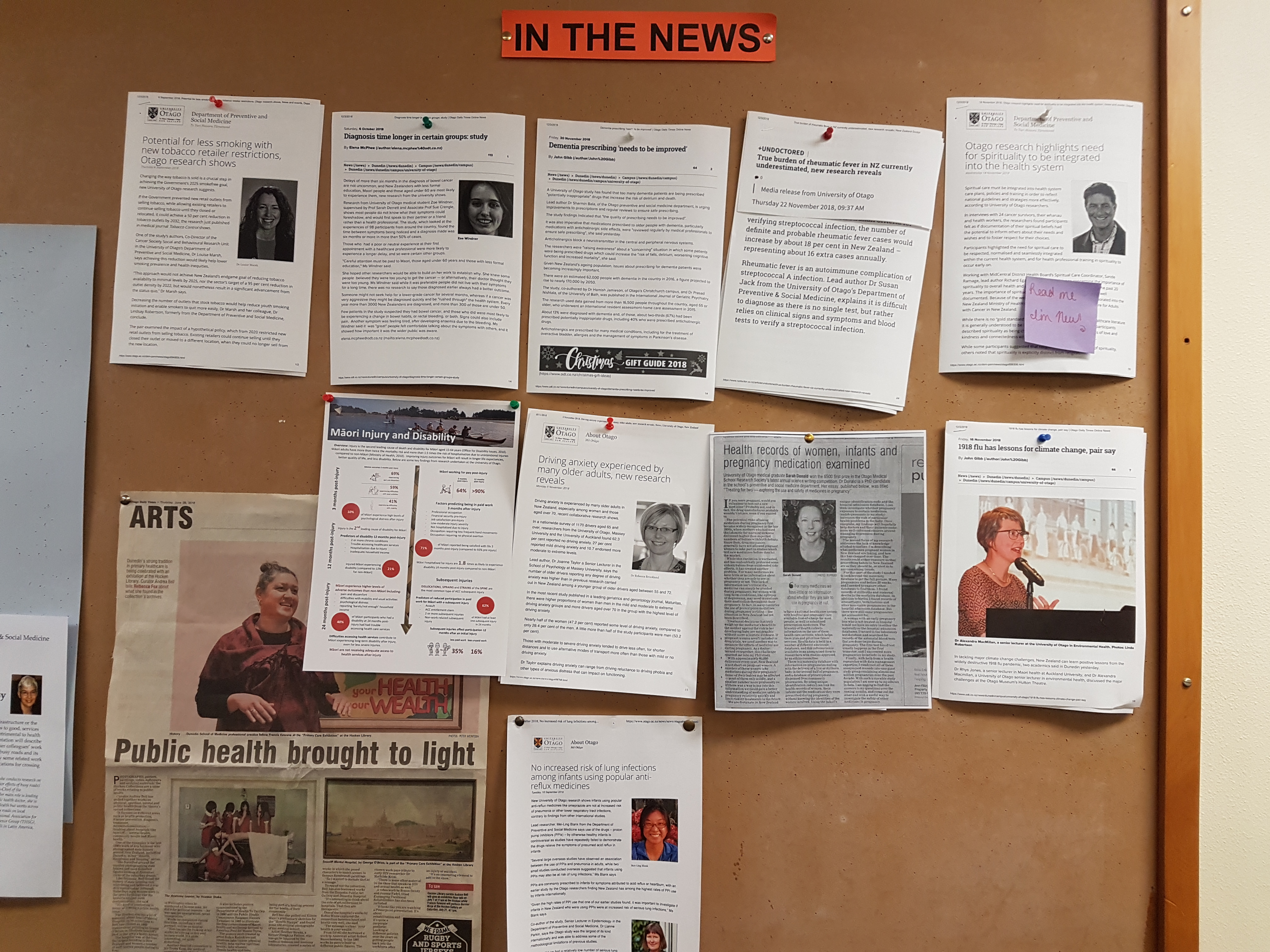
I spent the week of 4th March with Dr Alex MacMillan and her colleagues in the Department of Preventive and Social Medicine, the largest department in the university. It shares many features with the UCL Department of Epidemiology and Public Health, but has a few noticeable differences. One was the greater emphasis on ‘public health’ rather than ‘epidemiology’.
The departmental noticeboard
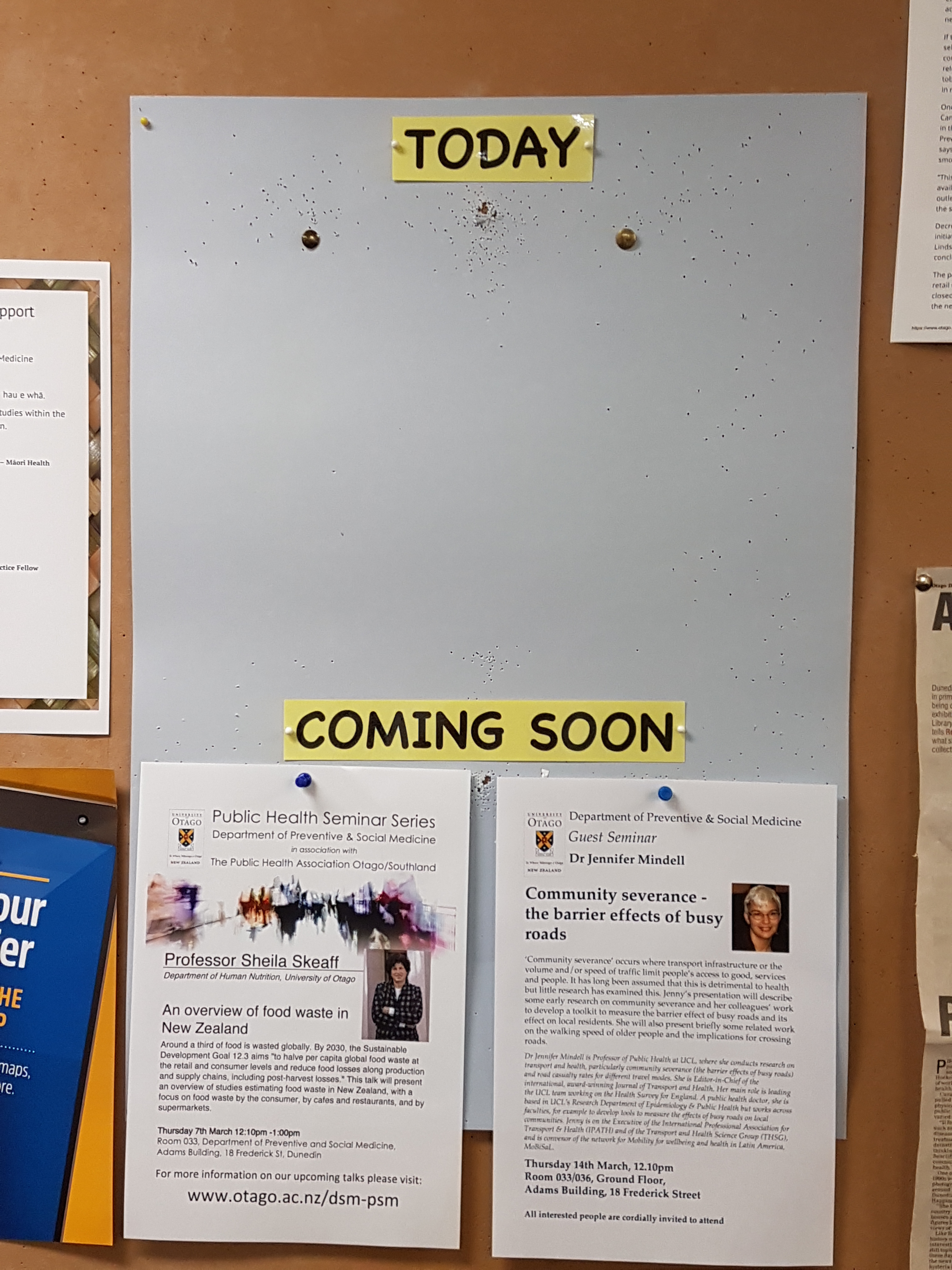
My talk to the department was actually the following week, as another seminar was already organised for this week.
This notice board seemed a good idea to publicise internal events.
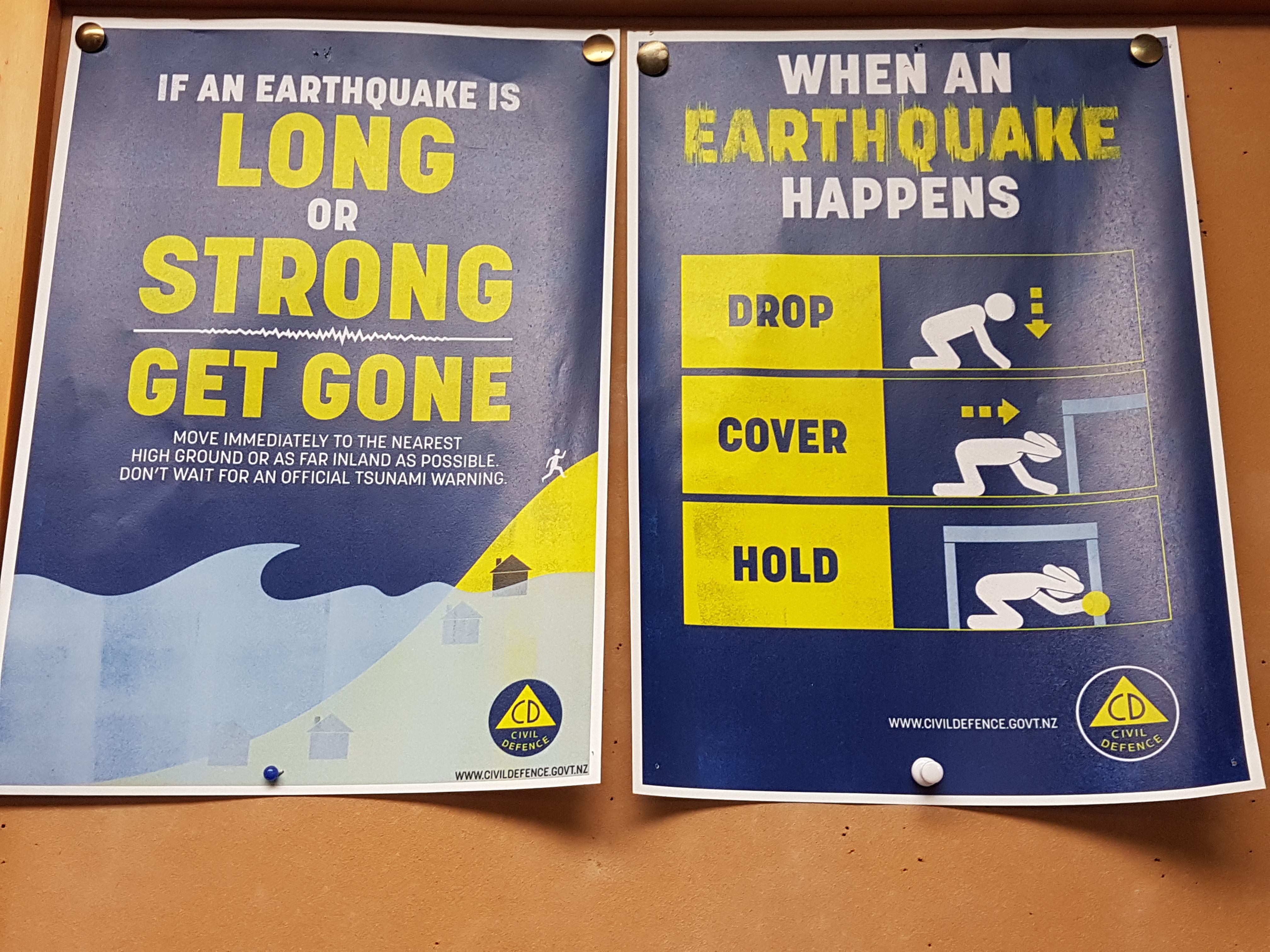
Not all notices in the department resembled those in London:
The other main event on the afternoon of Day 2 of TALES Symposium
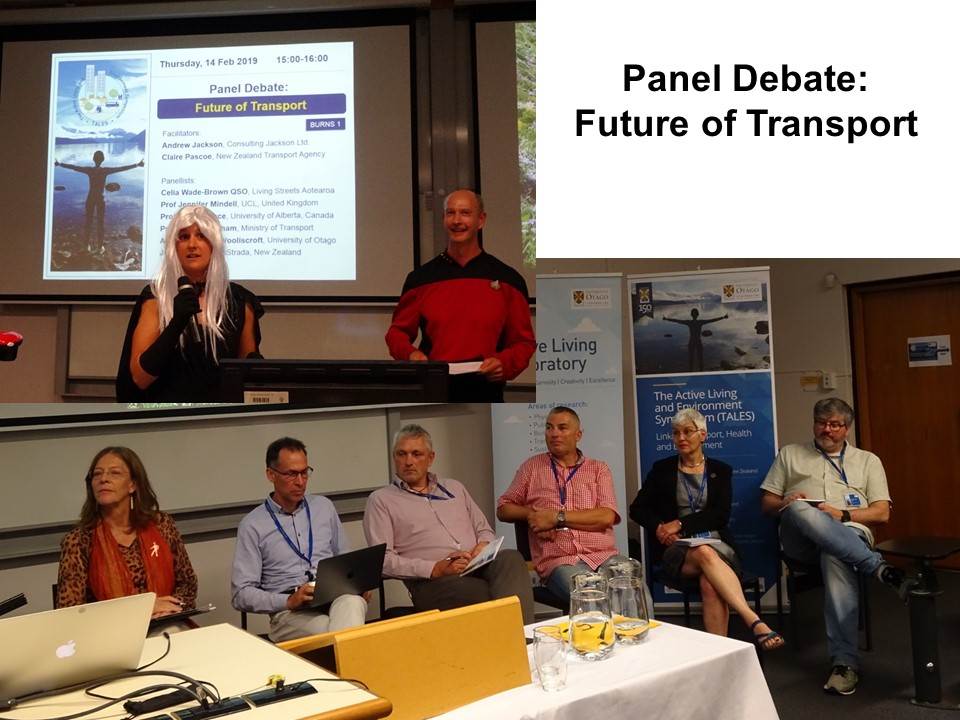
was a panel debating the future of transport in New Zealand. This was supposed
to be facilitated by Claire Pascoe, of the New Zealand Transport Agency, and
Andrew Jackson of Consulting Jackson Ltd. Much to everyone’s surprise
(including the panel members’), their places were taken by Storm and Jean Luc
Picard. The panel members, however, were as advertised: Ms Celia Wade-Brown,
QSO, of Living Streets Aotearoa; John Lieswyn, ViaStrada, New Zealand; Prof
Simon Kingham, Ministry of Transport, New Zealand; Asso Prof Ben Wooliscroft,
University of Otago, New Zealand; Prof Jennifer Mindell, UCL, London, UK; and
Prof John Spence, University of Alberta, Canada.
Car travel was the only mode that increased in New Zealand
between 1988 and 2013. Since then, there have been tiny increase in modal
shares for cycling and for public transport use, of 0.1% each. Media coverage
of the future of transport focuses on autonomous vehicles as the new utopia.
The discussion considered what we want from our transport systems, and what we
need to do, and what we need to do to get there. There was general agreement on
where we were trying to get to but the main debate was supposed to be
‘Evolution or revolution’? Storm argued for evolution, while Jean Luc argued
for revolution.
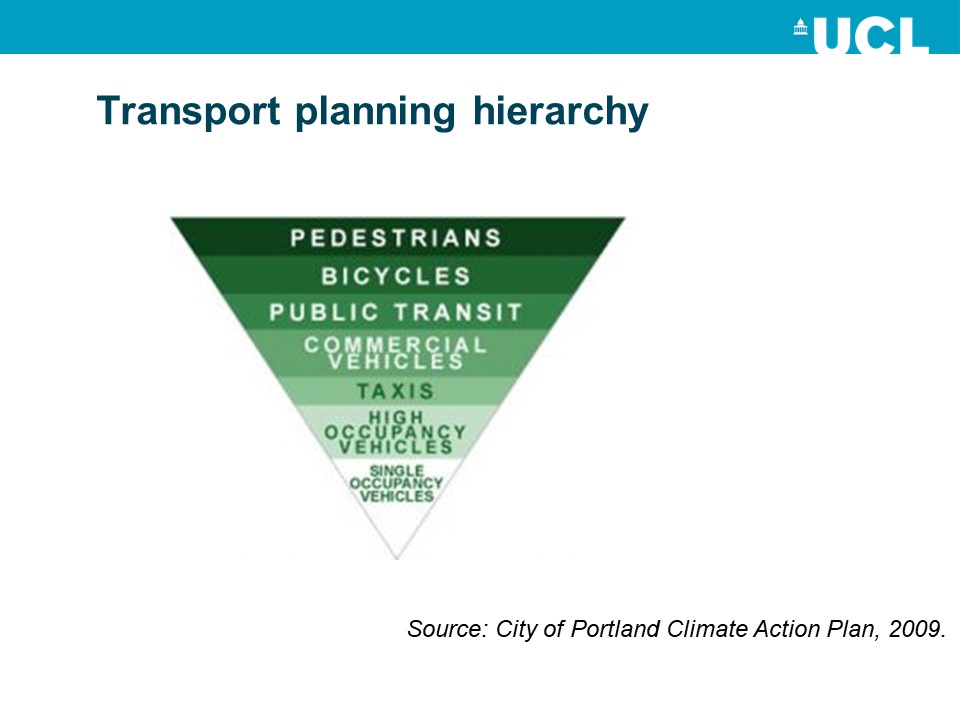
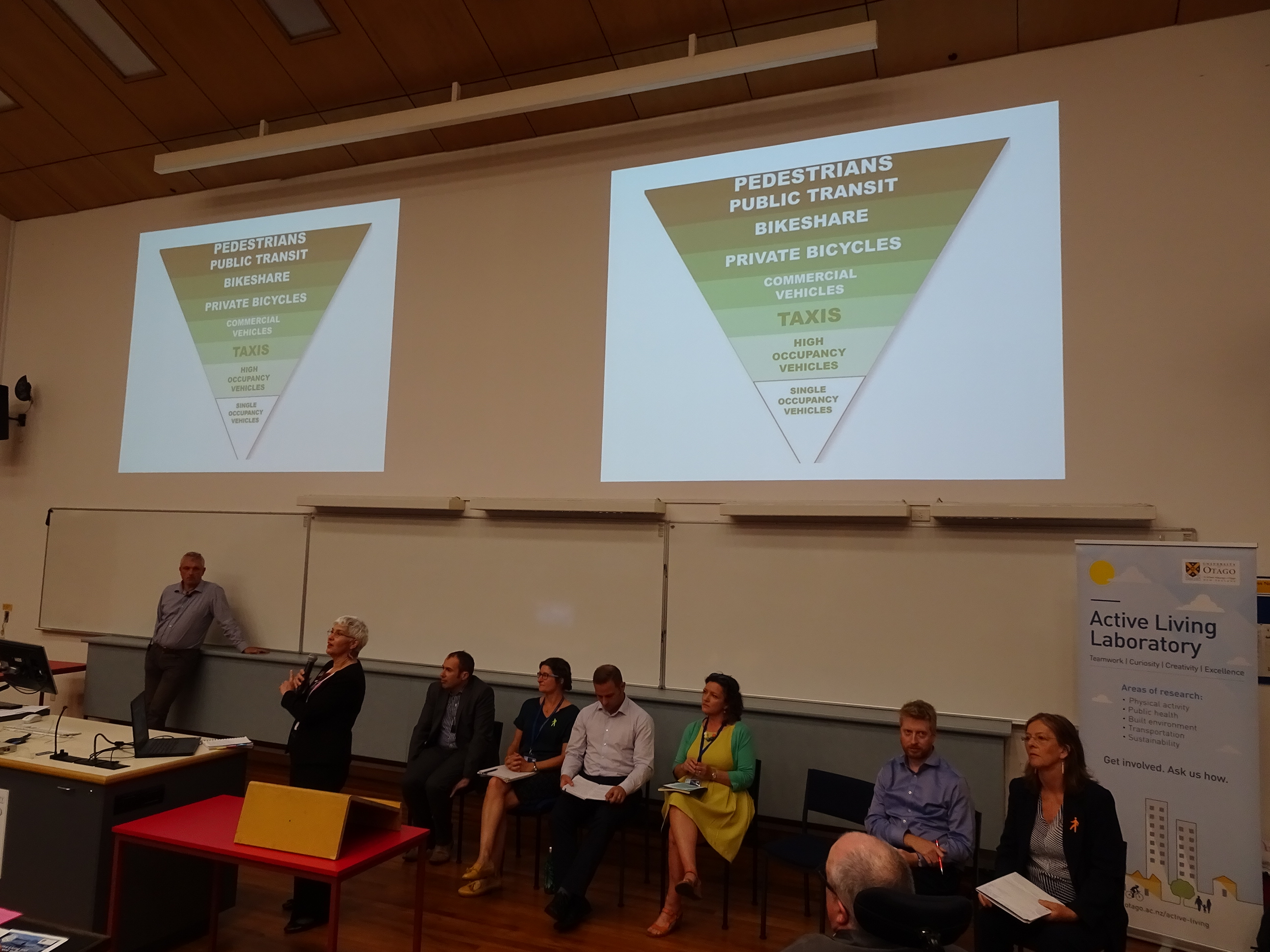
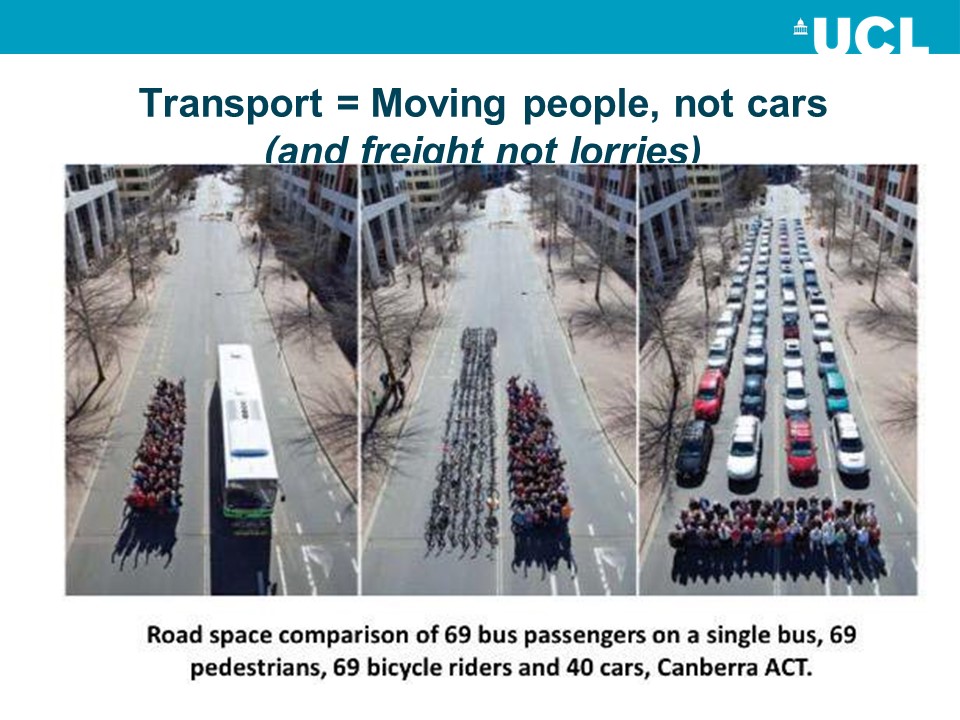
The discussion was excellent but it failed as a debate as all the panellists argued for revolution! My stance was that evolving systems had led to where we are now, and continued evolution would lead to more of the same – a focus on the supremacy of cars and little regard for those who can’t or don’t want to drive or be driven. Indeed, those wishing to walk, cycle or use public transport are often considered ‘lesser beings’. I was therefore a strong supporter for revolution. My key points were the need for slower speeds; inverting the hierarchy and the funding to match, so pedestrians have the top priority, followed by cycling and public transport, with sole use of private cars at the bottom; and a focus on moving people (and goods) not vehicles.
Transport facts and figures in New Zealand
Obesity in New Zealand is
the third highest among OECD countries.
Road travel crash deaths
have increased from 253 to 380 per year.
Car km increased from 38bn in
2013 to 44bn in 2018. Car use has increased from 79% ofall trips in 2014 to 82%
of trips in 2017 (although the good news is that this can change: car use has
fallen in Wellington).
Very few motor vehicles in
New Zealand are electric: the most recent, though already out-of-date, figures
were only 12,000 of the 4,000,000 motor vehicles in New Zealand.
The population in New
Zealand is predicted to increase from 4.9m to 7.1m by 2042 if it continues at
the recent levels of growth but at least to 5.6m if the rate of growth slows
(Stats NZ conservative estimate).
The number of people aged
65+ is estimated to rise from 700,000 to at least 1.3 million by 2050 – from 17%
to 22-26% of the population.
Urbanisation is predicted
to increase from the current 86% by 0.98% per year.
Changing the language
I emphasised the importance of reframing of road safety to
road danger reduction. The problem with ‘road safety’ is it leads to targets
that can be perverse incentives: we can have no child pedestrian casualties by
having no child pedestrians. Road danger reduction focuses on reducing the
danger to others from those who impose the risk. It is also important to
stimulate changes to culture, aided by changes in language. In the UK, there
has been a tendency to talk about investment in roads and subsidy of public
transport whereas if the externalities were included, it would be more obvious
that society subsidises private motor vehicle use.
tAs I was on the panel, I took no notes during the debate, so my thanks to Andrew Jackson for providing me with some missing stats and to Kirsten Coppell for hers on what was said, though I cannot tell you who said what. Any errors are mine, not theirs.
Infrastructure and changing the culture
Infrastructure for active travel is necessary but
insufficient. There is also a need to monitor, measure, understand and change a
lot more than the roads. We need a culture change, and we need to be able to
measure that culture. The law of supply and demand applies to parking, and policies
should be cognisant of that. Social connectedness is important for society and
for individuals’ health. Streets should encourage neighbourliness and social
contacts, not be a bar to meeting people.
Market forces
It is also important to consider the importance of market
forces, whether those who sell calorie-rich/nutrient-poor food and drinks or
the auto-oil industry. What are the economic levers that can be used to address
market distortions? I urged we should learn lessons from
successful tobacco control approaches, including legislation, litigation,
control of advertising and other marketing, and supporting attempts to deal
with addictive behaviours.
Aspirational targets and economics
These would include:
speed reductions to 30km/h
in cities and especially in neighbourhood streets;
a national policy to ban
sprawl, ensuring mixed land use and compact development to increase walkability;
incorporating movement
targets, such as 40% of trips to be walked, including a national walk to school
policy;
reducing single occupancy
vehicle;
reducing on-street parking;
and
tax breaks to promote
healthier forms of commuting and to address inequity.
As well as leading to greater car use and impeding active
travel, urban sprawl also imposes high costs for infrastructure (and not only
for transport). Costing tools for transport policies need to include the value
of time for all road users, not only drivers. Price can be used to reduce
parking. Road user charging is another mechanism. But it is important to be
careful of unintended consequences.
Sustainability
I was concerned that even with electric vehicles, the energy
still needs to be generated somehow, so would EVs merely displace the pollution
from the urban to other areas while still consuming fossil fuels. I was
reassured to learn that New Zealand has much higher renewable energy and much
less fossil fuel use than most high income countries currently, so this may not
be a problem.
After the debate
The weather had been glorious. The only time it really rained during the three days of TALES Symposium was at the end of day 2, when we had been scheduled to go for a walk in the Botanic Gardens. Instead, informal networking continued. Had we known about the rain from our windowless lecture theatre, the panel debate on the Future of Transport could have continued for longer instead of being stopped due to the time. But that would have delayed the final plenary session by Dr Christina Ergler, on young people’s own suggestions on improving a cycle skills training programme.
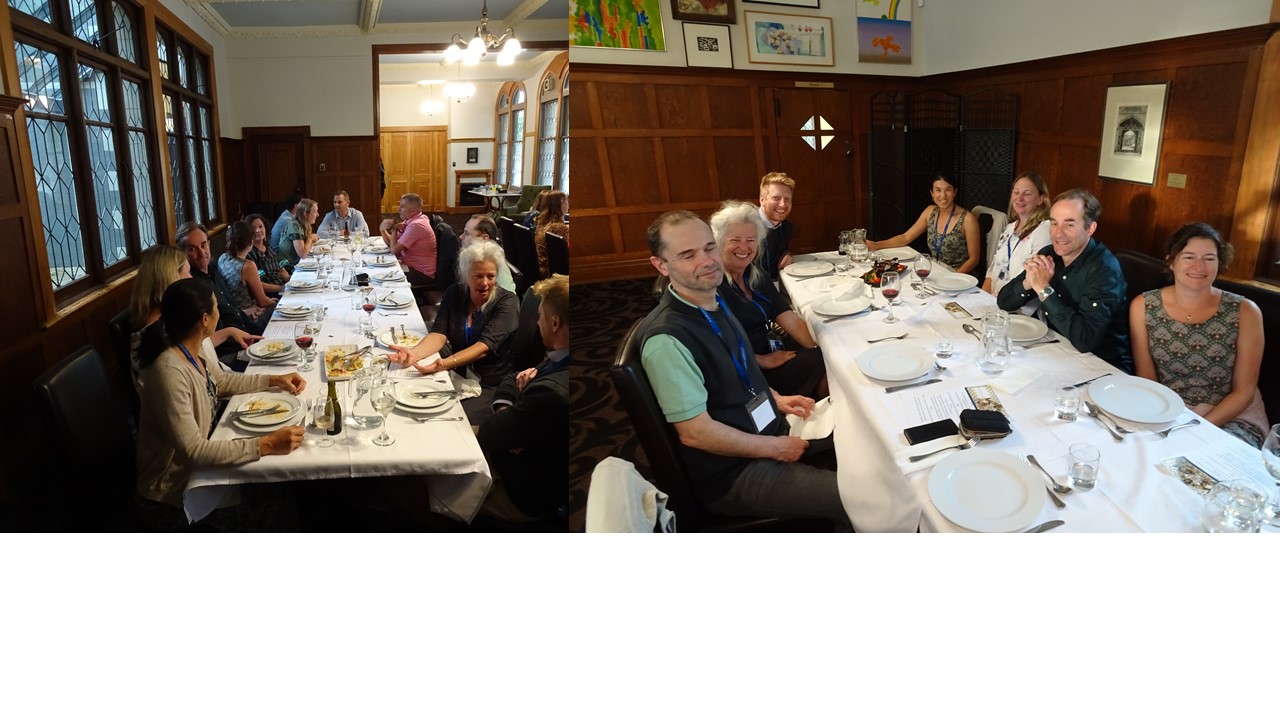
The day ended with a splendid dinner at the University of Otago, Dunedin, for more networking opportunities.
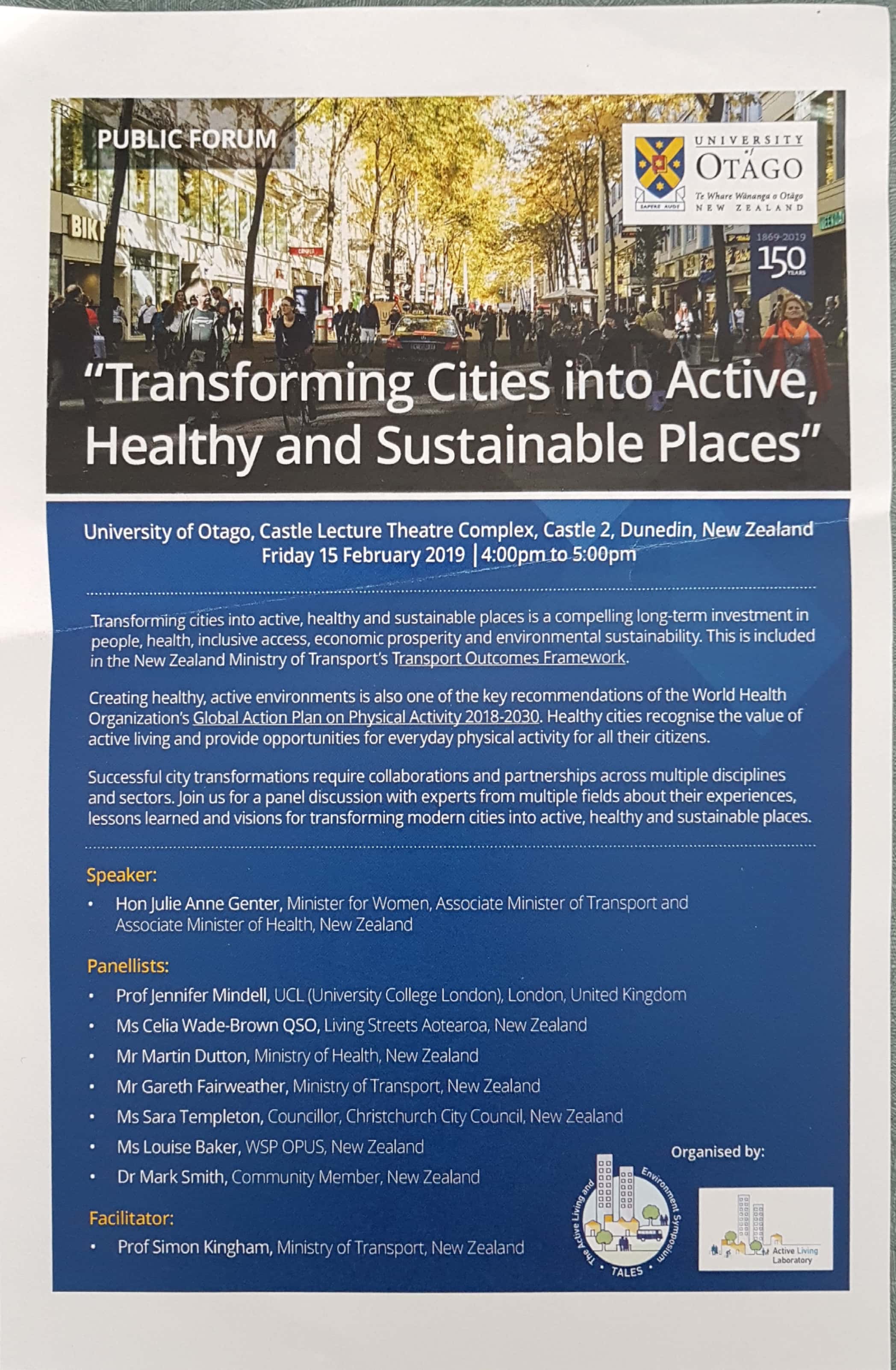
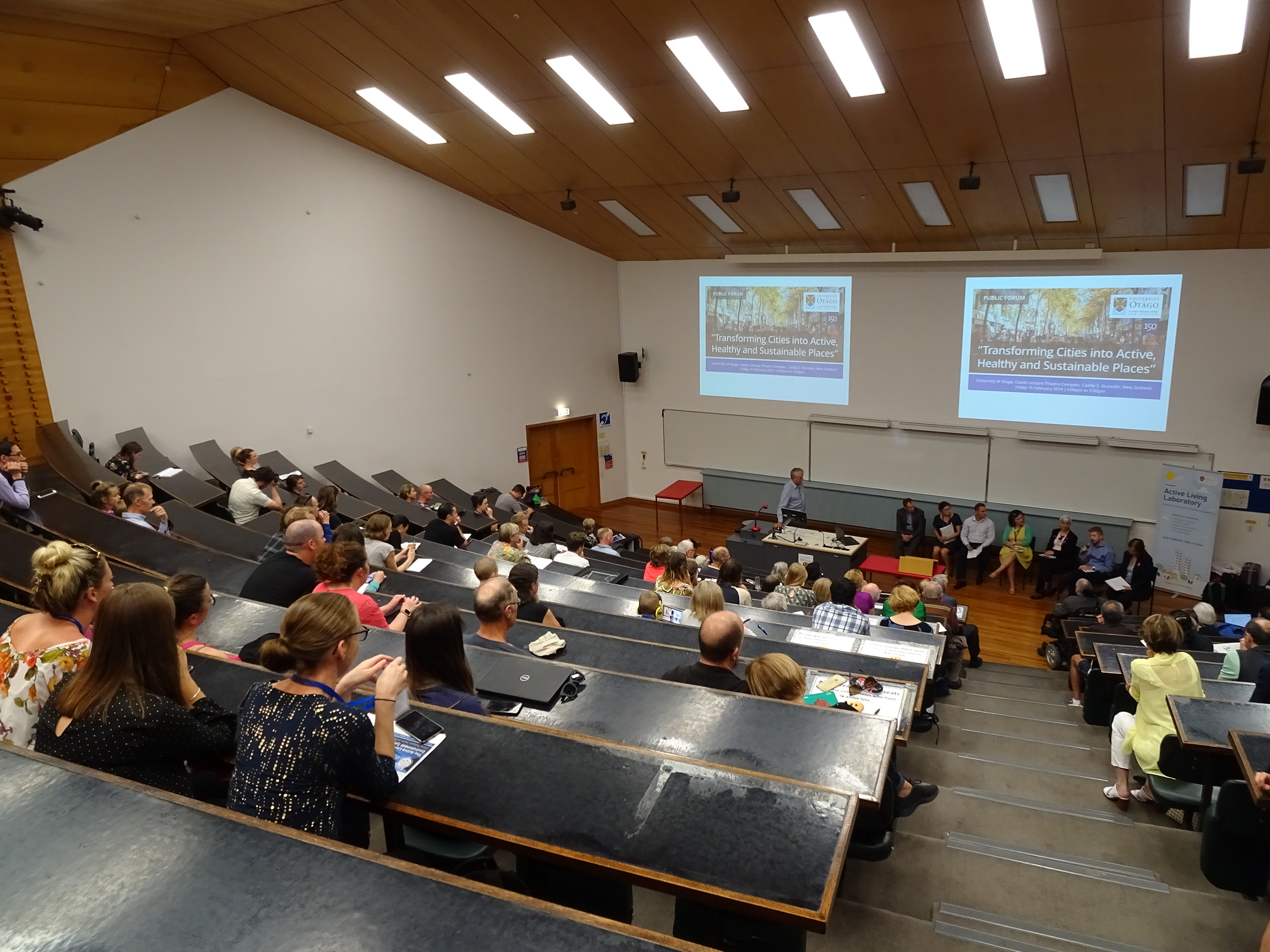
Immediately after the TALES symposium ended, there was a Public Forum on active travel. The Public Forum was chaired by Professor Helen Nicholson, the Deputy Vice-Chancellor External Engagement of the University of Otago.
The Honorable Julie Anne Genter, Minister for Women, Associate Minister of Health and Associate Minister of Transport had kindly agreed to be the keynote speaker, which she did by videolink from her office (with her bicycle in the background!) She said that current New Zealand Government has increased focus on wellbeing, walking, cycling and public transport.
This was followed by a discussion between the seven panel members, responding to questions from Professor Simon Kingham, the Chief Scientific Advisor to the New Zealand Ministry of Transport. He asked questions such as:
What is the biggest barrier to us transforming cities into healthy, active and sustainable places?
How much can technology (e.g. autonomous vehicles) transform cities into healthy, active and sustainable places?
What are the some quick/cheap ways we can start to transform cities into healthy, active and sustainable places?
Can we still ‘love the car’ and transform cities into healthy, active and sustainable places?
What is the secret to convincing the public that we might need to ‘unlove the car’ to transform our cities into healthy, active and sustainable places?
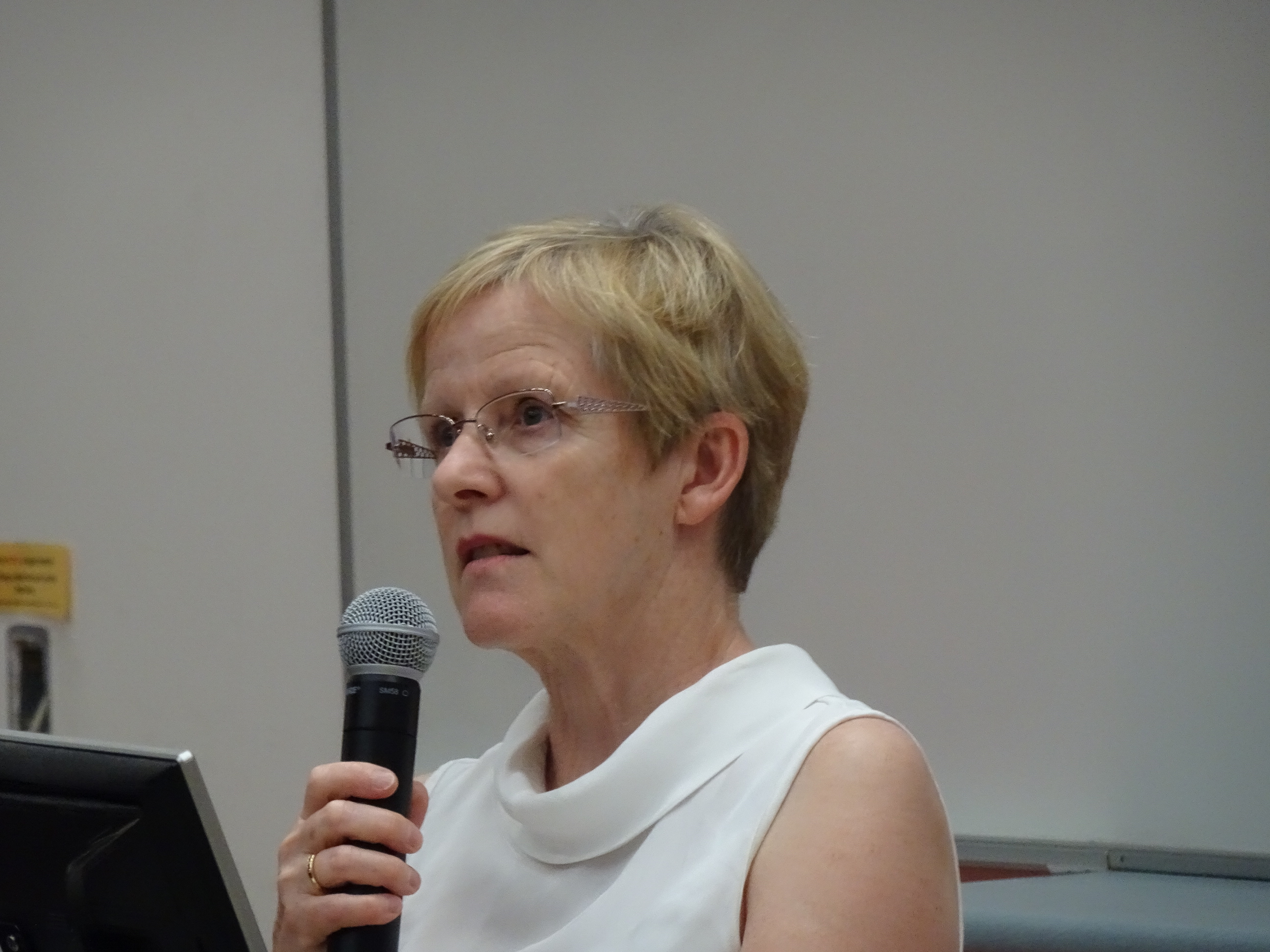
Professor Simon Kingham
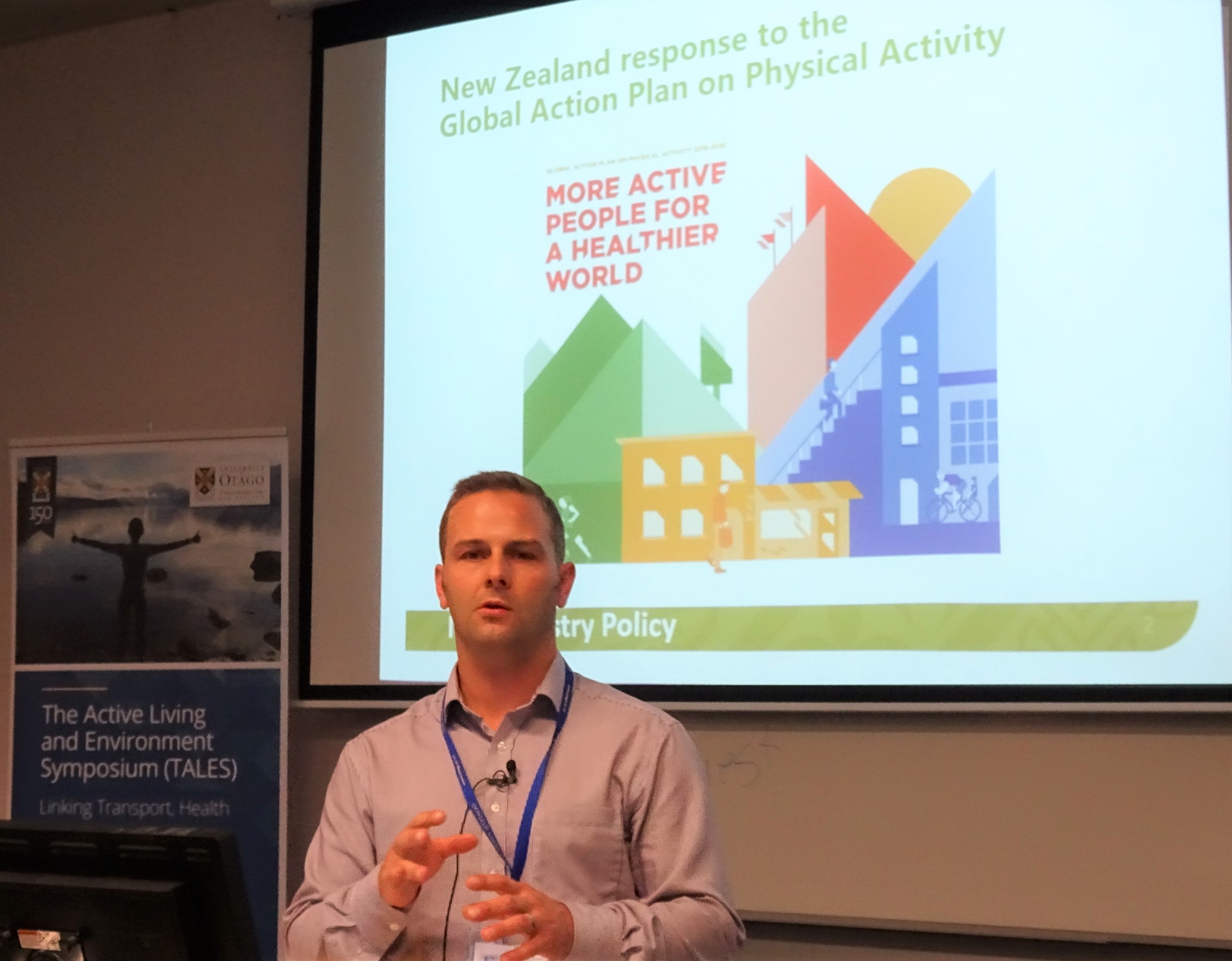
Martin Dutton, Senior Advisor on the Wellness, Nutrition & Pysical ACtivity Team in the Population Healht and Prevention section of the New Zealand Ministry of Health, told the audience that the Government has signalled its intention to support healthier, safer and more connected communities, and I believe that in order to do that we need to ensure that the environments that we live, work and play in support our personal mental and physical wellbeing. Access to nature and natural spaces is really important for our mental health too.
The Ministry of Health is encouraged to see wellbeing and the liveability of places reflected as the purpose of the transport system in New Zealand. The Ministry of Health supports the inclusion of inclusive access, health and environmental sustainability as key outcomes in the Ministry of Transport’s ‘Transport Outcomes Framework‘.
In addition, government agencies are working together to try to make the healthy choice the easy choice, by working out how to engineer everyday movement back into our lives, to improve our independence and social mobility. One of the best ways to do this is to make active transport as appealing as possible for people. We need to be thinking about designing urban spaces that are inclusive and healthy, especially for those who may not currently use the streets through fear (ie older people, people with physical disabilities, people who have visual or hearing impairments, younger children).
Martin Dutton, speaking earlier at the The Active Living and the Environment Symposium
My own points were that policy-makers and practitioners need to invert the traditional transport planning hierarchy, putting pedestrians at the top and sole occupancy private motor vehicles at the bottom when making provision for travel, whether infrastructure, legislation, or other policies. Just as importantly, funding needs to match this set of priorities. For example, good quality pavements (sidewalks to readers from the USA) and footpaths should be a priority everywhere. Our aim should be to reduce private car use dramatically and increase walking, cycling, public transport, and other active modes.
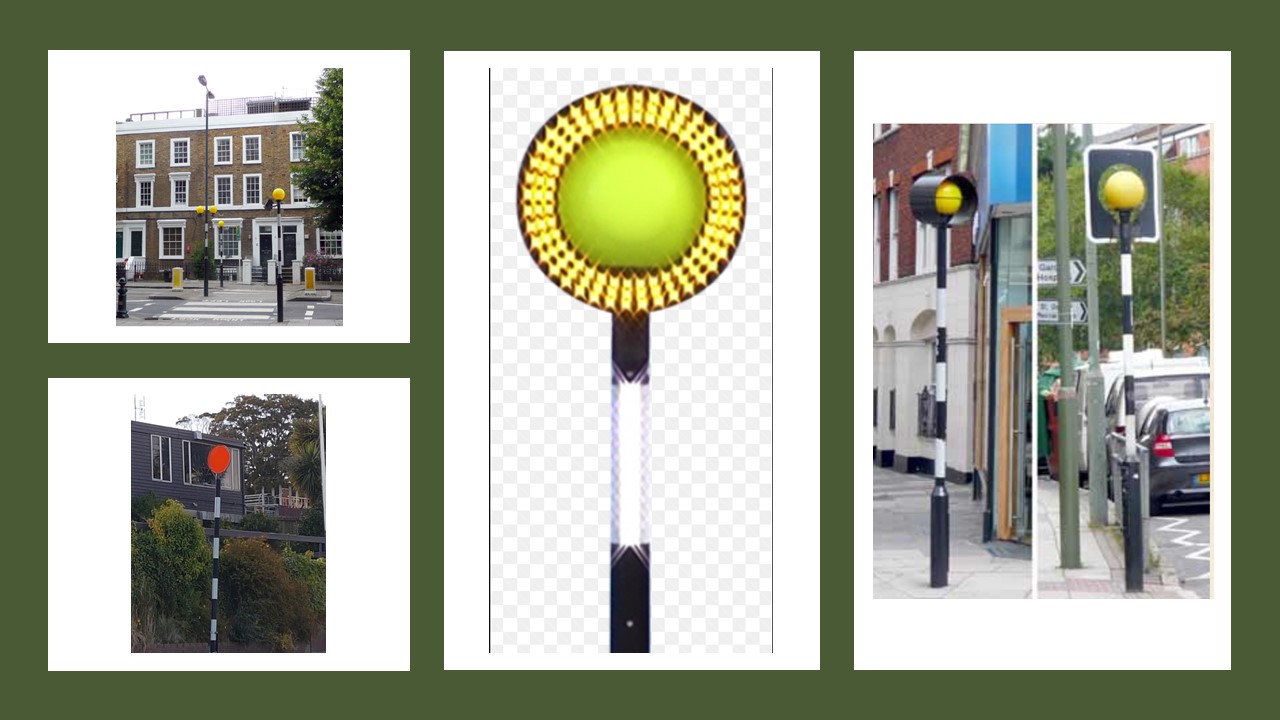
We need slower speeds in all residential streets, and especially around schools. We need Safe Routes to Schools and encouragement for children and teenagers to walk (or cycle) to and from school. More pedestrian crossings are needed. If signalised, they need to allow sufficient time for those who walk more slowly (e.g. most older people and those escorting young children) to be able to reach the other side – and roads in Dunedin are very wide! I have been told that there is a problem in New Zealand with Zebra crossings, because drivers often don’t stop. In that case, the correct response should be to deal with drivers, not to abolish the crossings! Having Belisha beacons (that contain flashing lights and alert drivers that they are approaching a crossing and to watch out for pedestrians) instead of the orange discs would help.
Four types of Belisha beacons and the so-called ‘Belisha disc’ of New Zealand. FRom top left: traditional beacon; LEDs, so use less electricity; shielding local residents from the flash; increasing visibility to motorists. With apologies to anyone whose copyright I unintentionally broke.
The second important area is to internalise the externalities. By this I mean, ensure that users of each travel mode pay what use of that mode actually costs society. Even if cars and fuel are taxed, drivers pay a fraction of the costs to others from injuries, air pollution, greenhouse gas emission, and their own increased risk of chronic and often fatal diseases (diabetes, circulatory diseases, cancers, depression, osteoporosis) caused by physical inactivity and prolonged sitting.
Public transport needs to improve, particularly the quality, frequency, hours of running (especially early and late buses) and routes. I have blogged about buses before. Public transport needs to be available, affordable, acceptable, appropriate, and accessible.
We need to change both cultural norms and the environment to make the healthier choice (which is also healthier for the planet and future generations) the easier choice.
Everyone was so engrossed in the discussions that the session overran by half an hour, with almost everyone remaining until the end. We had to leave before the building was locked but the felling was that the conversations could have – and will – continue for much longer.
My last day at work was Friday 5th April. We invited some friends we had made in Dunedin to tea at our place on the Saturday afternoon. Sunday 7th, we left Dunedin to drive to Tekapo. En route, we went to Oamaru, which reminded us of Brighton. It has a pedestrianised shopping street preserved from Victorian times.
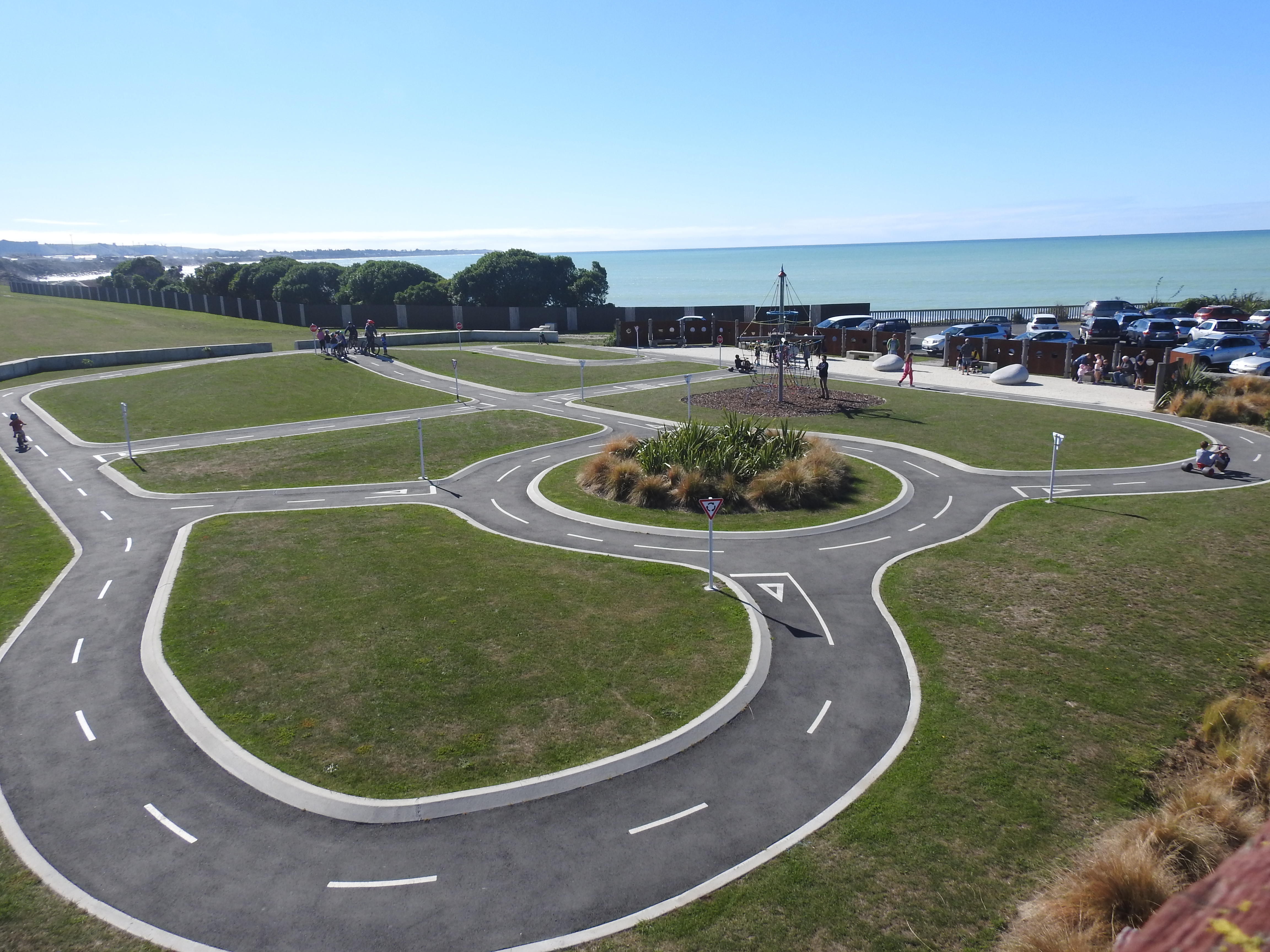
It also had a very clever children’s play street layout (playout?)
We went a slightly longer route through canyons of eroded sandstone, including seeing the Elephant Stones.
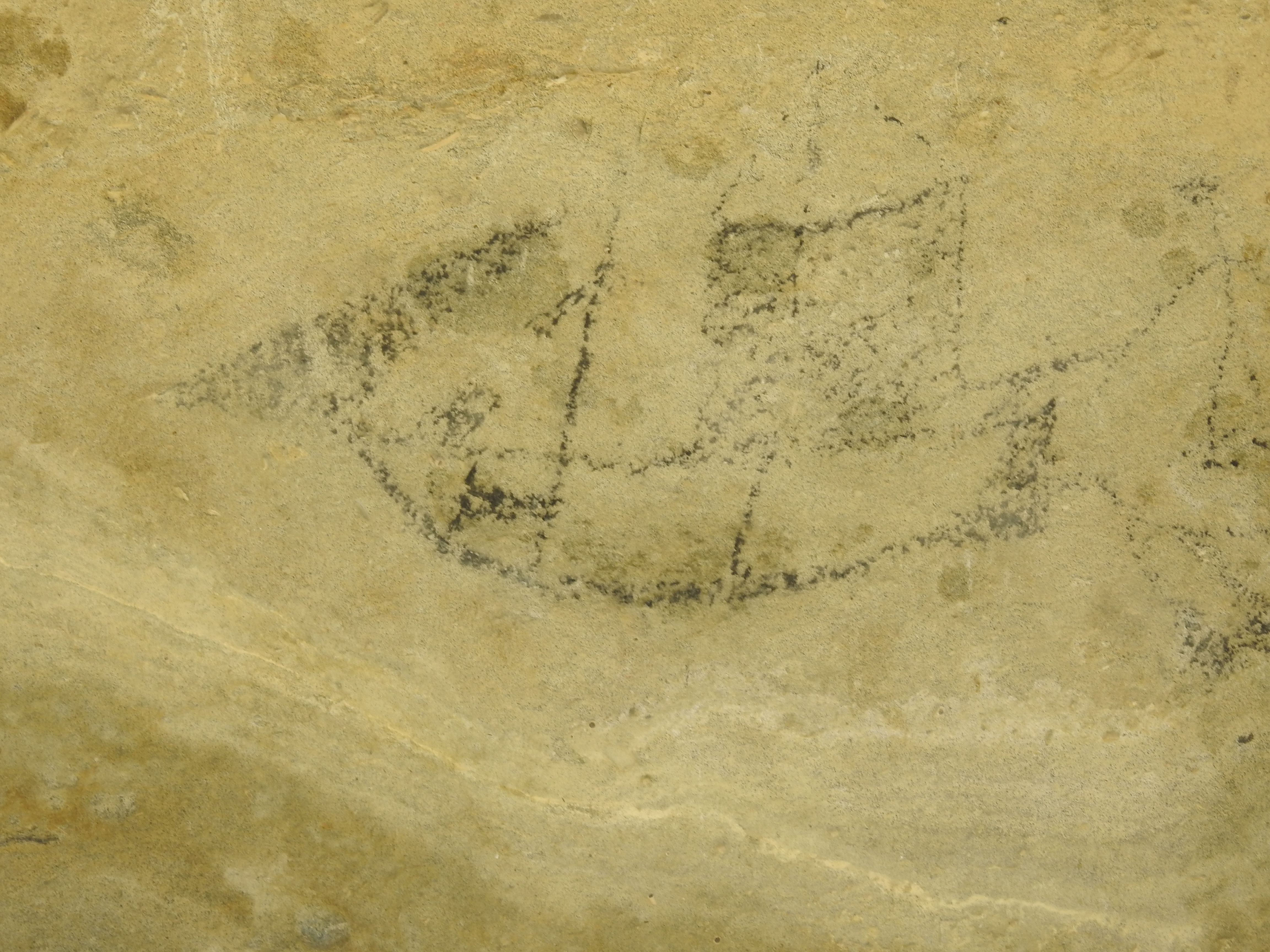
We also saw some Maori rock drawings.
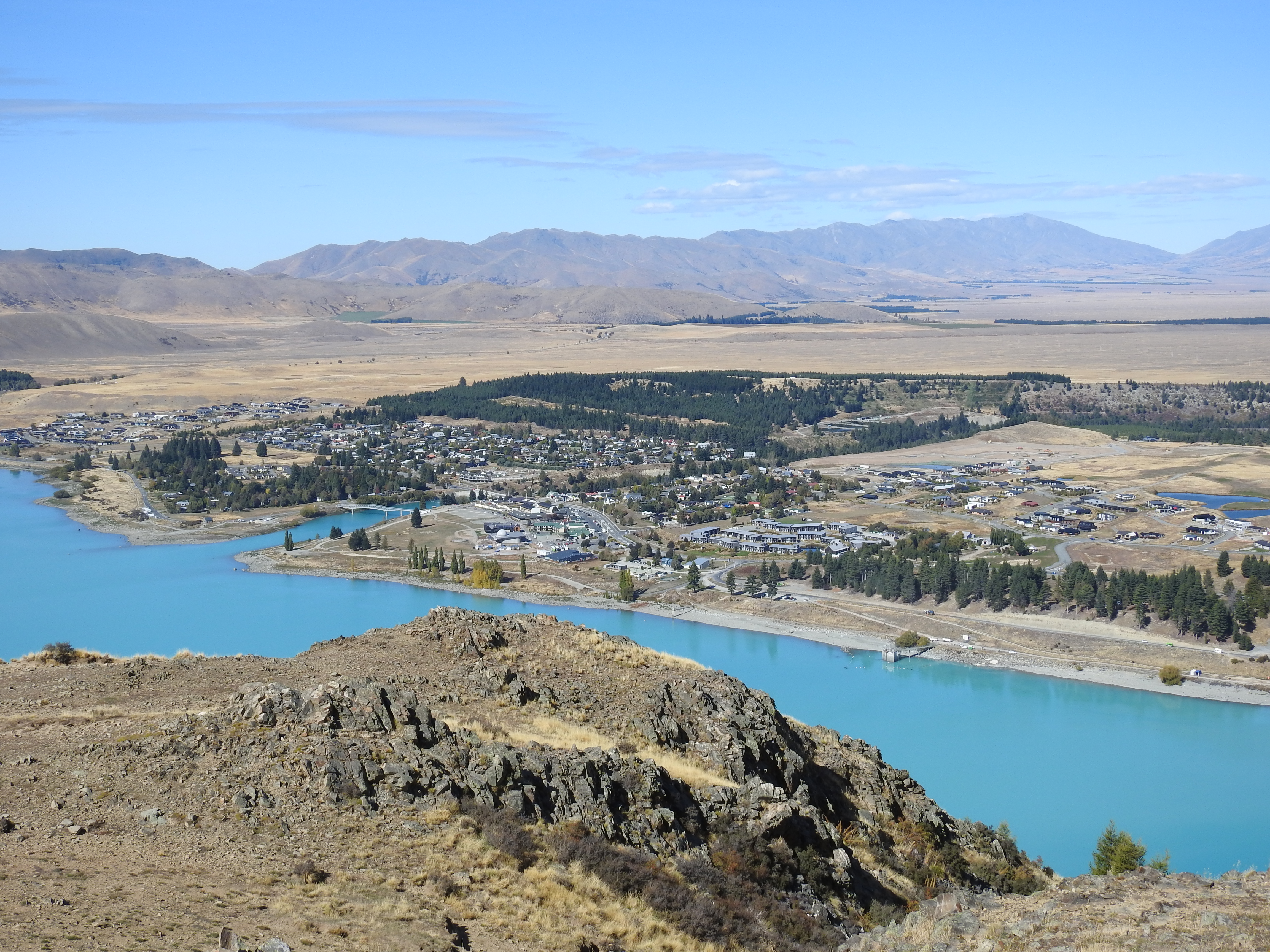
Tekapo is a village with 318 residents, according to the 2013 Census, plus tourists and holiday home weekenders.
Tekapo (2,380′) as seen from the top of Mt John (3,380′)
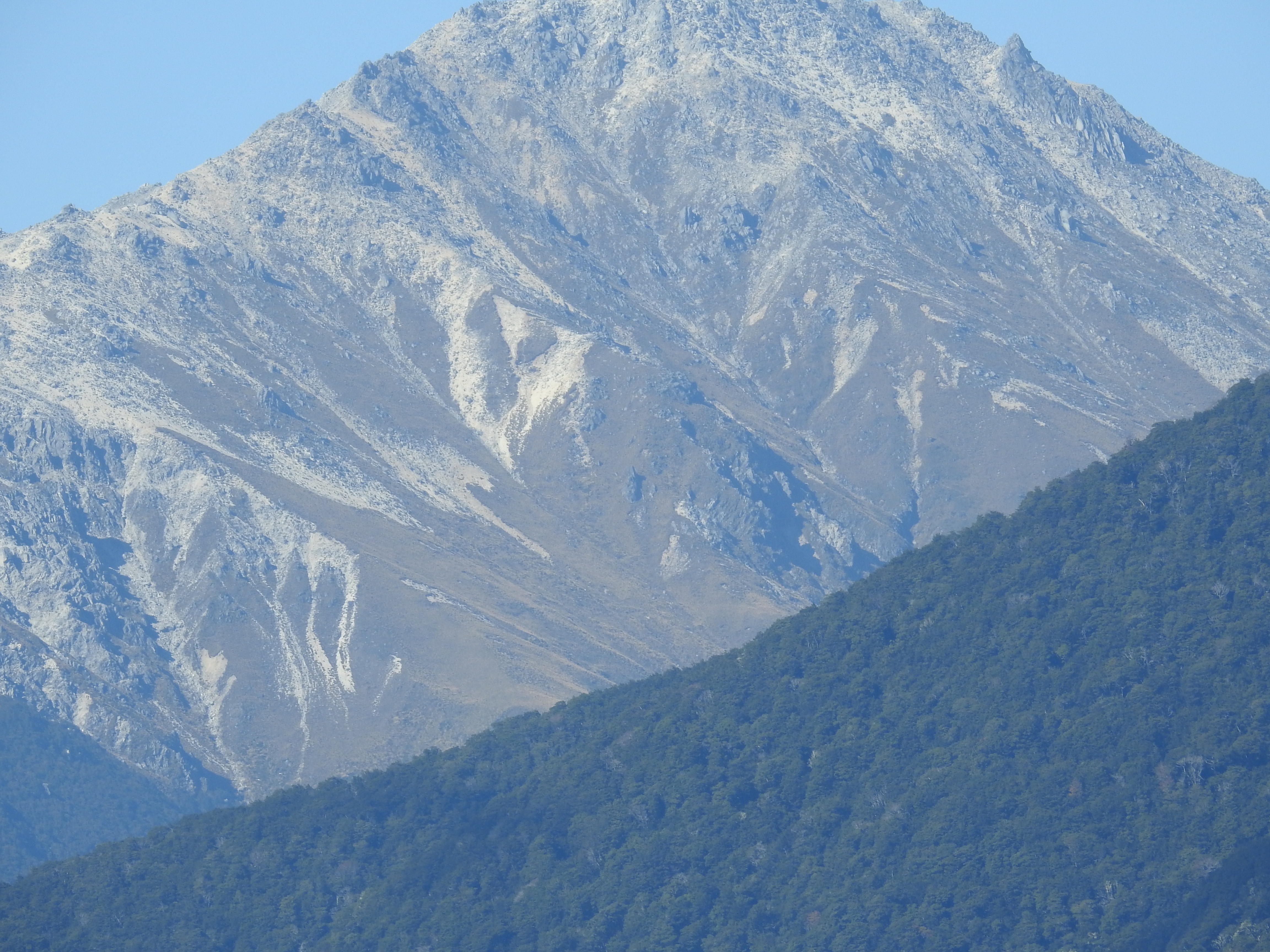
On the Monday, we backtracked to visit the Aoraki Mt Cook reserve and went to the Visitor centre and also the Edmund Hillary Alpine Centre. We walked along the trail to Kea Point, from where we could see the upper end of Mueller Lake, then along the first part of the Hooker trail to the Hooker Lake and River.
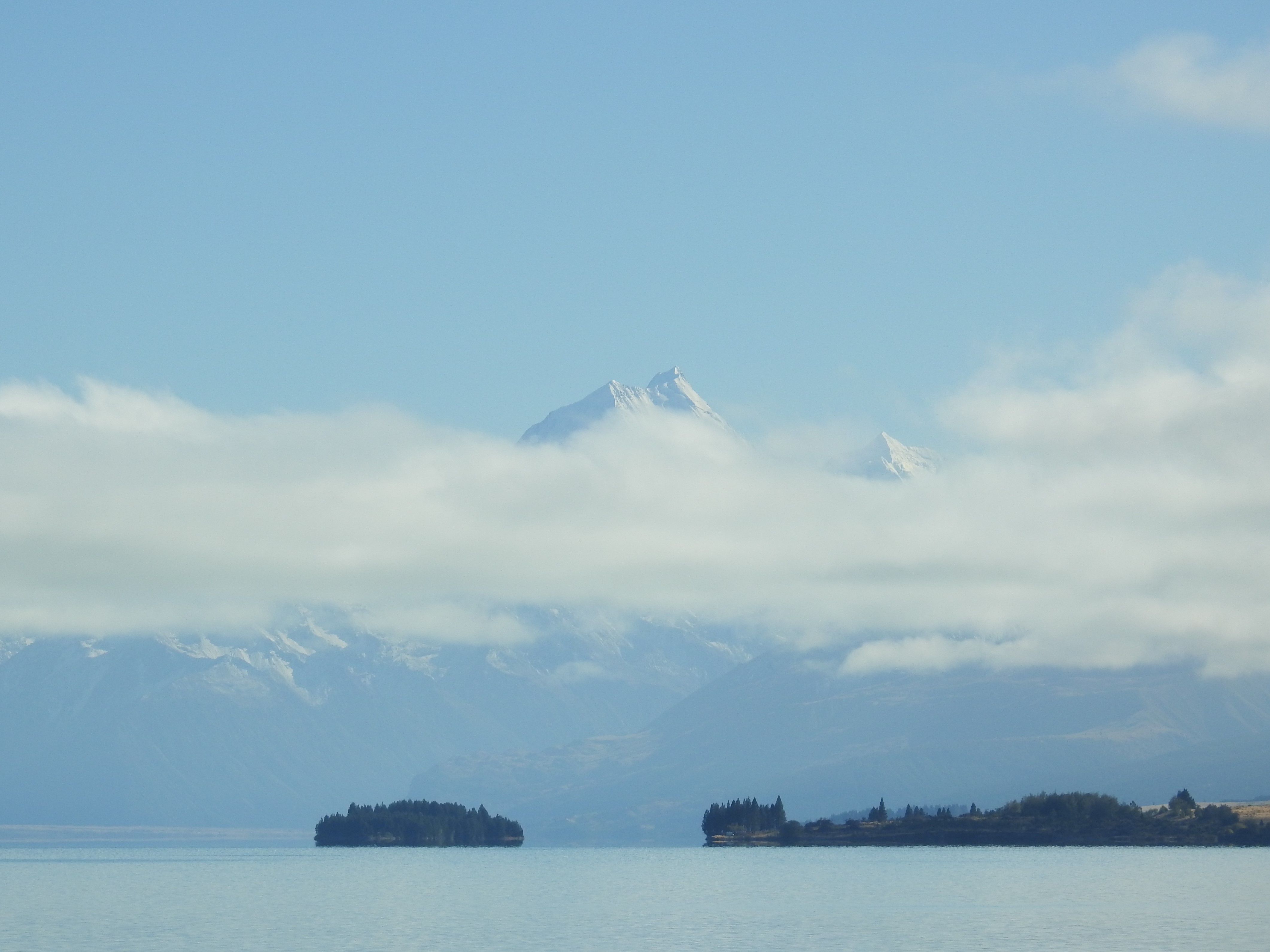
Aoraki (Cloud Piercer), also known as Mt Cook
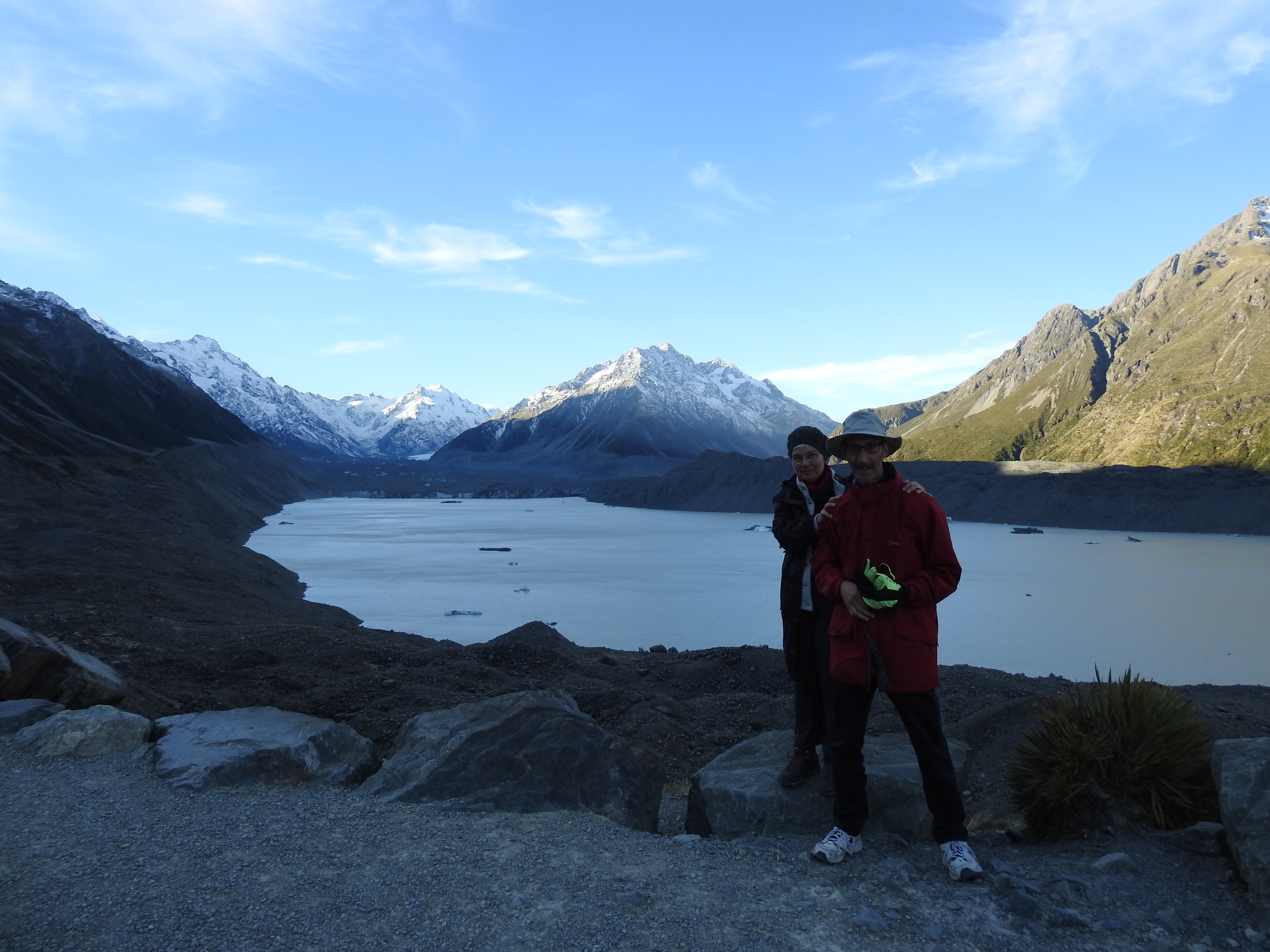
We then drove to the Tasman Valley and climbed up a trail to see the Tasman Glacier (sadly now much diminished in length and depth) and Lake Tasman.
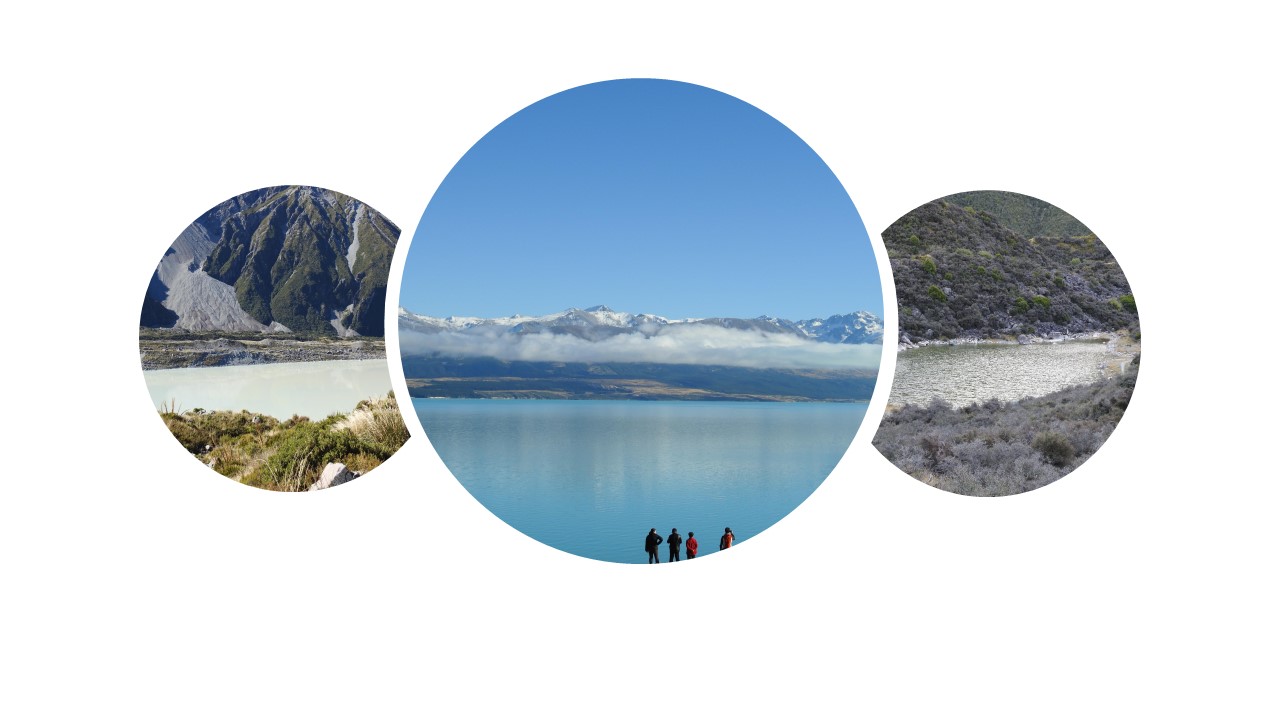
Lakes created by glacial meltwater contain ‘glacial flour’, the result of the glacial action grinding the rocks very finely. Close to the glacier, the water appears a muddy grey because it contains so much glacial flour (e.g. Lake Mueller). Lakes Pukake and Tekapo are a brilliant turquoise blue because most of the glacial flour has settled but the flour still suspended in the water makes it appear turquoise. The Blue Lakes are now green because they are no longer fed by glaciers but by rainwater, which allows algae to grow
Grey water in Mueller Lake; Turquoise blue water of Lake Pukaki; but the Blue Lake is now green.
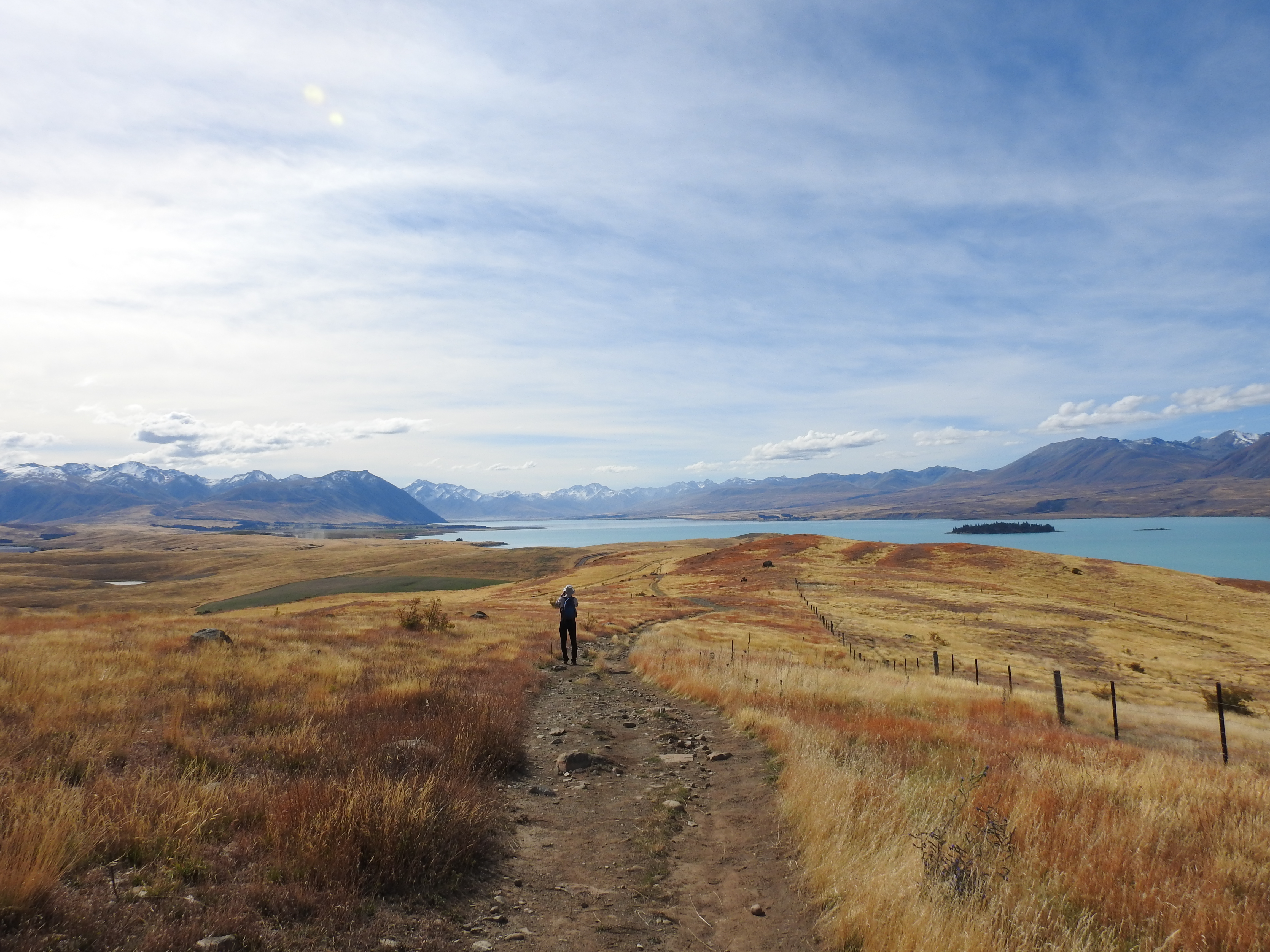
Tuesday was spent walking up Mt John then back down along Lake Tekapo.
View of Southern Alps and Lake Tekapo on our way down form Mt John
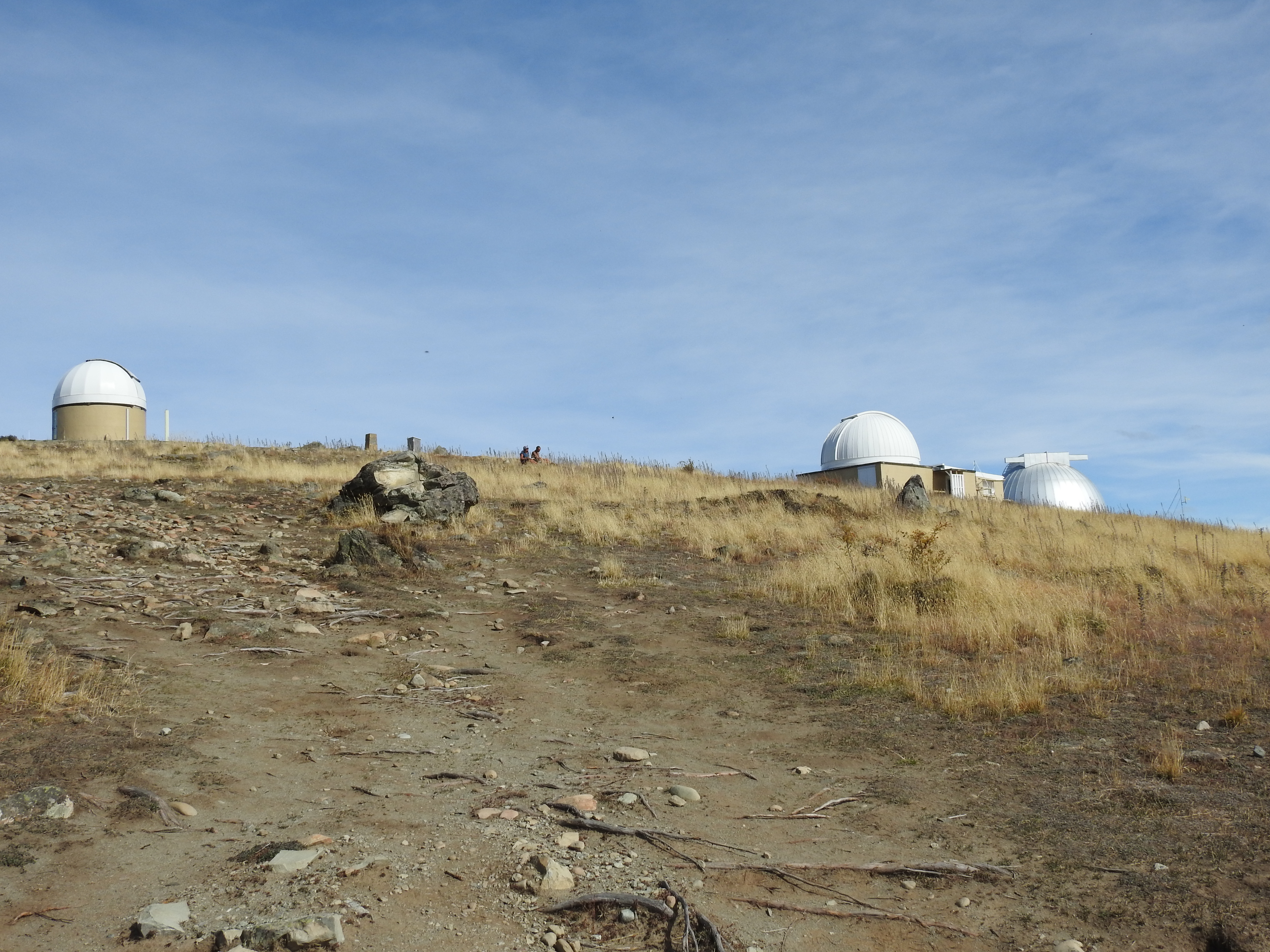
We had visited the Mt John Observatory on the Sunday evening, which luckily had 0% cloud cover and an almost new moon, so visibility was perfect. The whole area is a ‘dark sky reserve’ so even the street lights in Tekapo are yellow and shielded to give light only downwards. We learnt how to find the South Celestial Pole using ‘the pointers’ (alpha and beta Centauri) and the Southern Cross, or Crux; saw Jupiter and four of its moons; saw the Omega Centauri cluster of a billion stars orbiting a black hole; saw Jupiter’s Ghost through one of the main telescopes; and had a group photo with the Milky Way as the backdrop.
We had intended spending Wednesday on a bike ride but as
rain was forecast and Akaroa sounded so interesting, we decided to leave Tekapo
a day early and have an extra 24 hours in Akaroa….
I was shocked by the tiny proportion of trips in New Zealand that are undertaken by public transport or walking (less than 10% for each), even in towns and cities (except Christchurch). There are large costs to society from the use of private motor vehicles; these externalities are not paid by car users but by tax payers and the individuals exposed to air and noise pollution and those injured by cars. The families of those harmed by these effects from motor vehicles also suffer financially and emotionally.
It has been estimated that increasing active travel would
prevent 1,300 deaths annually in New Zealand overall, whereas a move to
autonomous vehicles would result in an additional 600 deaths per year overall.
New Zealand has socio-economic inequalities in both benefits
and harms from transport – possibly even more so than in the UK.
A car park in Christchurch cost $32m, paid for by
ratepayers, yet there are complaints about paying for cycleways – even though
there were 40,000 trips cycled in Christchurch in 2018.
Active travel to school (as has been shown in adults for
commuting) is in addition to other physical activity, not a replacement of
other forms of physical activity, in general.
How important it is for
researchers to engage with politicians and the community at an early stage in
planning research, and to work collaboratively across disciplines and
organisations throughout a project, not just when disseminating findings at the
end.
It is important to examine
walking and cycling separately, in terms of barriers, facilitators, attitudes,
policies and interventions and not assume that anything regarding ‘active
travel’ applies equally to both modes. There are also other active modes (non-motorised
scooters, skateboards) that should be considered in planning, both as modes to
increase physical activity and to consider the impacts on other active
travellers.
Children’s views are
important. Walking to school can provide time to talk with parents and with
friends. A child’s-eye view of the street can also yield important
perspectives.
The concept of ‘lovable cities’
– which combine the best aspects of complete streets, healthy streets, and
green streets, welcoming people rather than vehicles. Such streets would lead
to slowing the motor traffic and prioritising conditions for, and valuing,
people rather than prioritising those who have isolated themselves in mobile
metal boxes.
The importance of
changing the language if we want to change long held views and assumptions. For
example,why do politicians and the road lobby talk about investing
in roads but subsidising public transport?
The importance of learning
from behavioural science to change people’s longstanding behaviours: physical
activity must be FUN: Fulfilling, Useful, and/or Necessary.
The importance of
considering ‘the messy bits’ between infrastructure research/engineering and
consumer decision research, e.g. legislation, regulations, enforcements, media
reporting and advocacy, cultural and societal norms.
The need for connectivity.
This probably related to streets and/or different transport modes but also
relates to multi-disciplinary and cross-organisational working (and even
working across departments within an organisation)!
Economic evaluation must
include values as well as costs, and not just economic values.
Social media, advertising
and marketing influence people’s perceptions of travel mode.
I learnt the concept of
‘availability bias’ – being influenced by the most recent news (even if it is
about a rare event, such as a cycling fatality).
I also learnt about
‘adaptive challenges’ (versus technical problems). Read an earlier blog to find
out what these are!
As one of the participants
said, we should be aiming for ‘opt in’ not ‘opt out’ when it comes to active
travel modes.
Visual images
There were some fabulous slides shown during the three-day symposium.
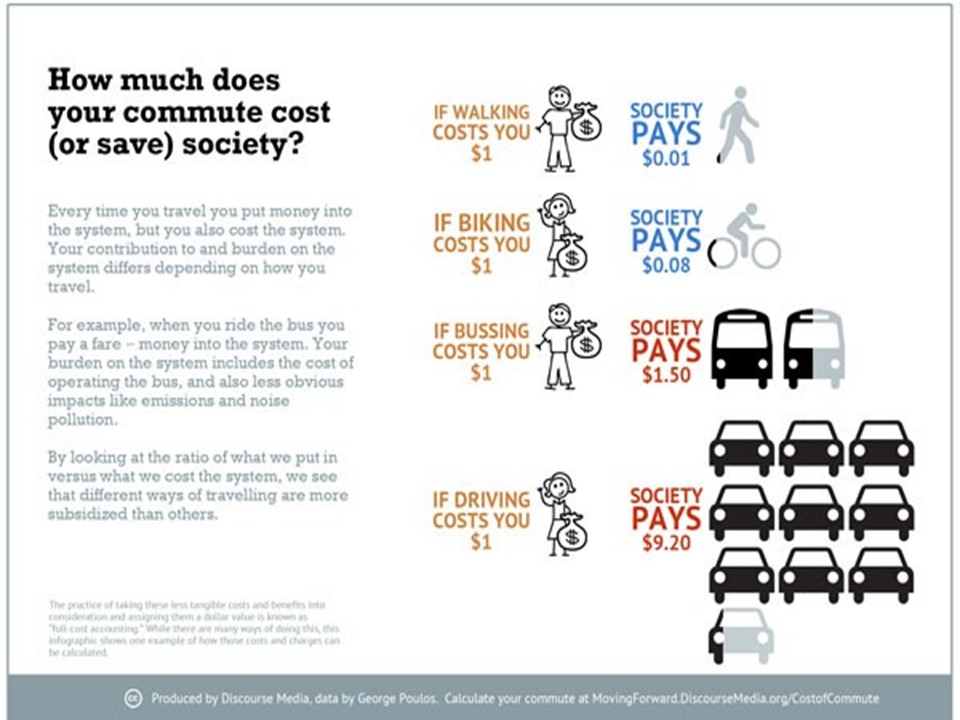
My prize for an infographic goes to Alexa Forbes’s slide from Vancouver of
societal costs of travel.
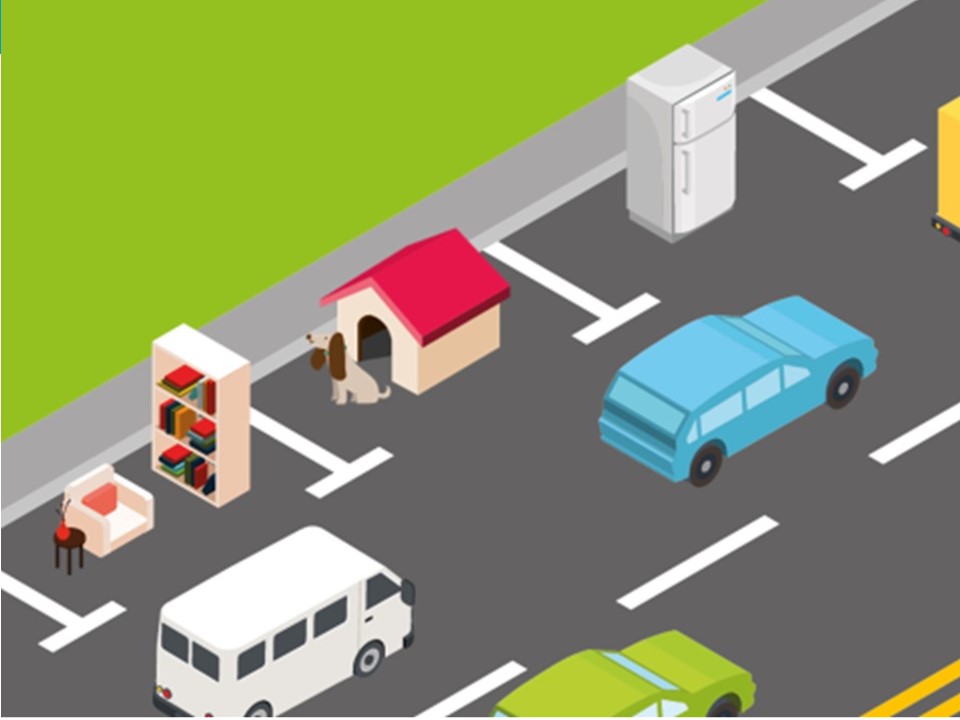
My favourite slide was about why parking is so accepted but
the concept of storing public property on public streets is, frankly, weird!
Final thoughts
‘Active living’ and ‘transport and health’ are overlapping Venn
diagrams. The more people there are in the overlapping area, the
less important the other parts are for health and especially for negative impacts
on other people. ‘Active living’ and ‘transport and health’ also overlap with sustainability
(‘co-benefits’ in current jargon).
Mode shift is a ‘wicked
problem’ but a raft of interventions and policies can work
synergistically and can be effective: we can learn from successful approaches
with other problems, such as tobacco control. For a healthy transport system,
we need to improve the built environment, change cultural and social norms,
provide information, advocate, and change the fiscal and legislative
environments, with political commitment and funding. Easy! We also need to
remember ‘latent demand’.
Finally, there are many opportunities for collaborative
research projects. Count me in!
The UK Met Office weather forecasts give the likelihood of rain, not how heavy it will be. And it’s often wrong. But so is the NZ MetService. We were told that the Norwegian weather forecast is the best, wherever you are – but that got it really wrong some days, too.
Don’t be fooled into expecting a lake-edge trail to be flat. Off road. ‘gentle undulations’ in Norwood speak (i.e. rather hilly).
If you packed a bike tool and mudguard in your luggage, bring it with you when you go cycling.
Unsegregated, shared-use paths work very well all over New Zealand. Pedestrians and cyclists (and skateboarders, though not necessarily e-scooter users) are generally courteous and considerate.
There’s no shame in walking up hills pushing your bike. If you feel you
need an excuse, “my knee/back is playing up and I don’t want to make it
worse” works well. “I was in the wrong gear” implies incompetence. My
favourites are “it burns more calories pushing a bike uphill than riding
it” and “I want to take a photo”.Take your rainwear with you.Take your
own rainwear with you, yourself; if someone else kindly carries yours,
he may be way ahead when you need it.Distances in New Zealand are
long.Avoid cycling on main roads
Cycling in Dunedin
The hills! I mean, really, THE HILLS! (and not just Baldwin Street, the steepest street in the world. David got almost halfway up)
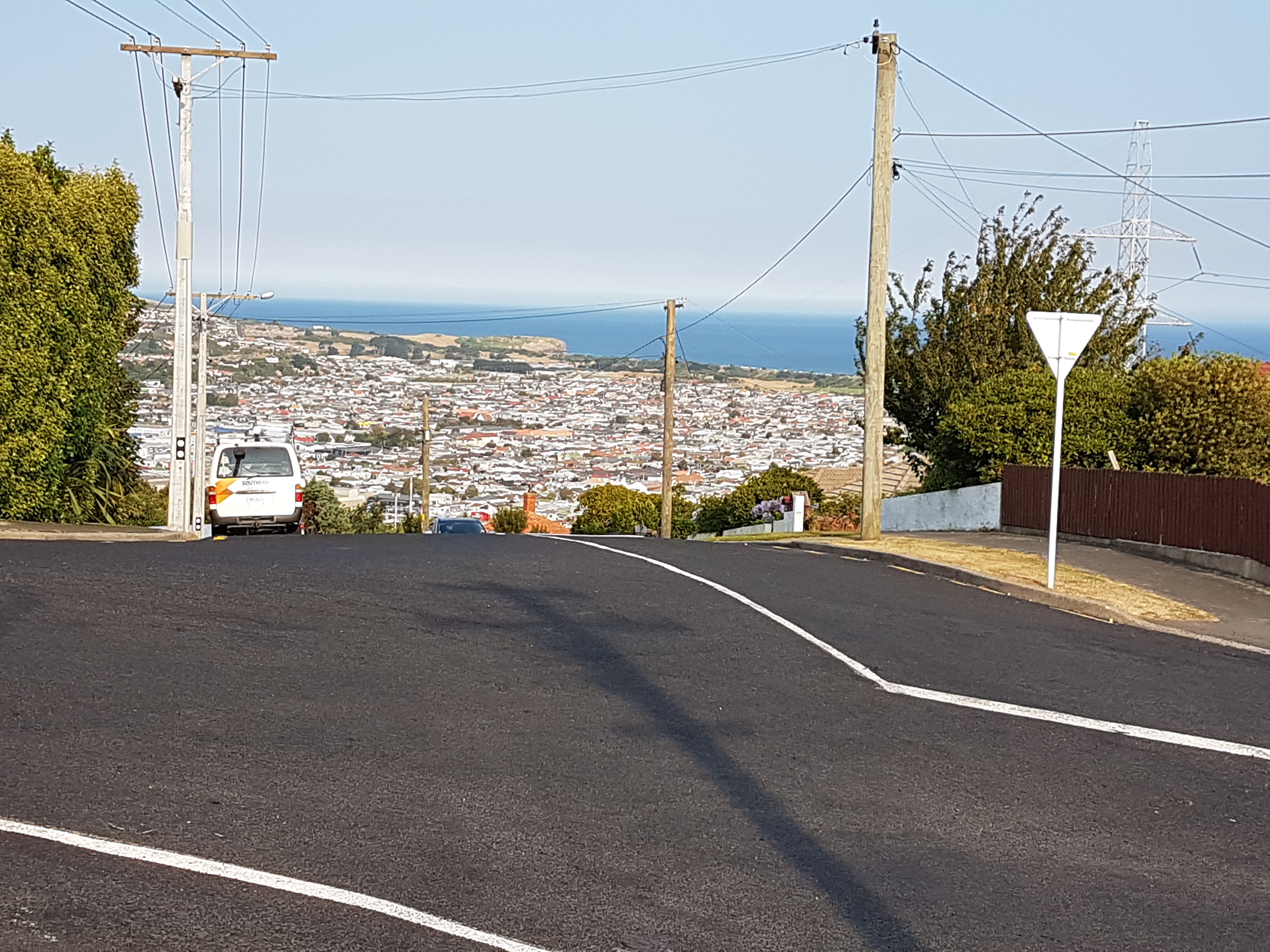
At the T-junction at the bottom of our street in Maryhill. By no means the steepest treet in the vicinity
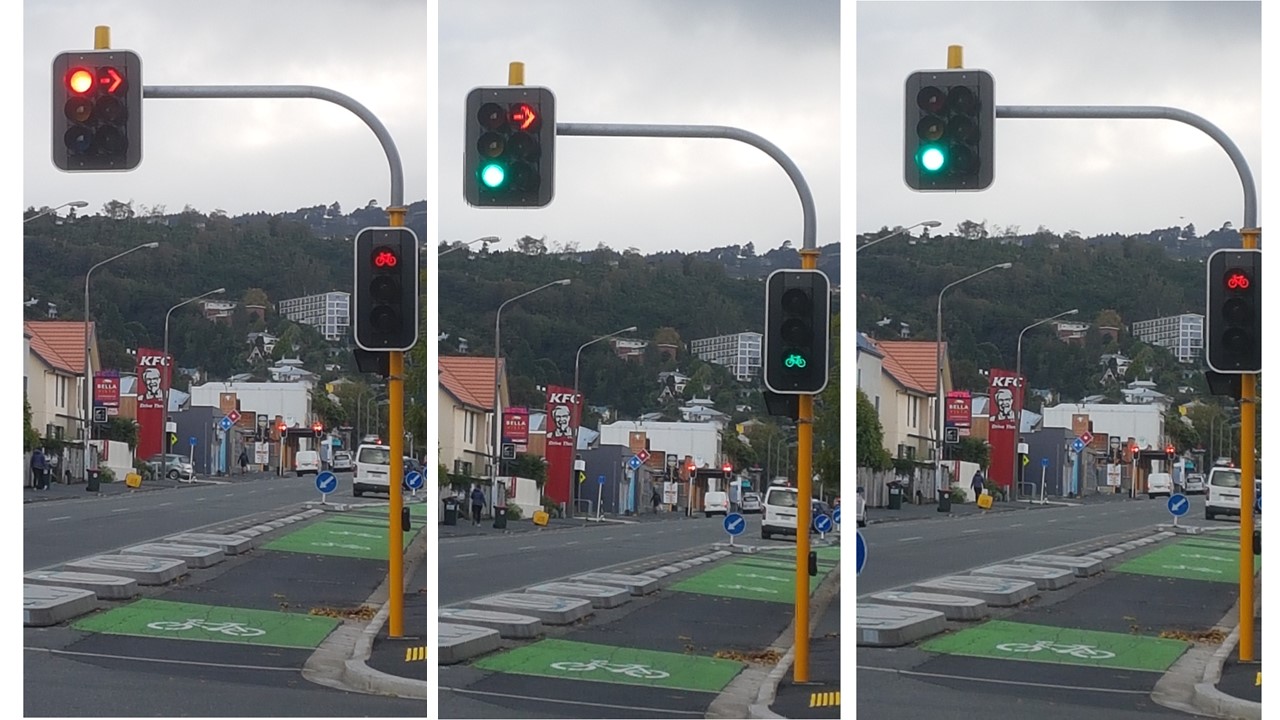
There are new segregated cycle lanes along the one-way State
Highway 1 through the city centre.
There are traffic lights at every junction, more-or-less. Sometimes cyclists have priority over turning cars (controlled by traffic lights). Sometimes turning motor vehicles go first and cyclists must wait. Sometimes there are just a single set of lights for motor vehicles and cycles. It seems totally random, so you never know what the next junction will be like. Must be just as confusing for motorists.
Sometimes the segregated lane is on the left of the street. Sometimes it’s on the right. Seemingly at random, you go through a junction on the green light and realise too late it said ‘Cyclists cross with pedestrians’ and suddenly you’re across the junction and your lane has gone – but it’s now on the other side of the road, with three lanes of fast-moving cars and lorries in the way.
When you’re on the left, there’s no way to turn right at a junction (and vice versa) except getting off the bike and crossing at the pedestrian lights. Imagine if car drivers were expected to do that!
Despite the good barriers, I was nearly ‘doored’ by a coach that decided to open its passenger door across the cycle lane as I was approaching. Ho hum! But apart from that, they’re great.
Not sure (doubtful – geddit?) if you can keep track of our time travelling. We’re now back to Tuesday 21st February, early in our week’s holiday near the start of our stay in New Zealand.
The day after our visit to Milford Sound, we drove 20km from Te Anau to Pearl Harbour, Lake Manapouri, where we caught the boat across the lake to West Arm. The rain and wind made the previous day seem quite dry relatively speaking!
Lake Manapouri
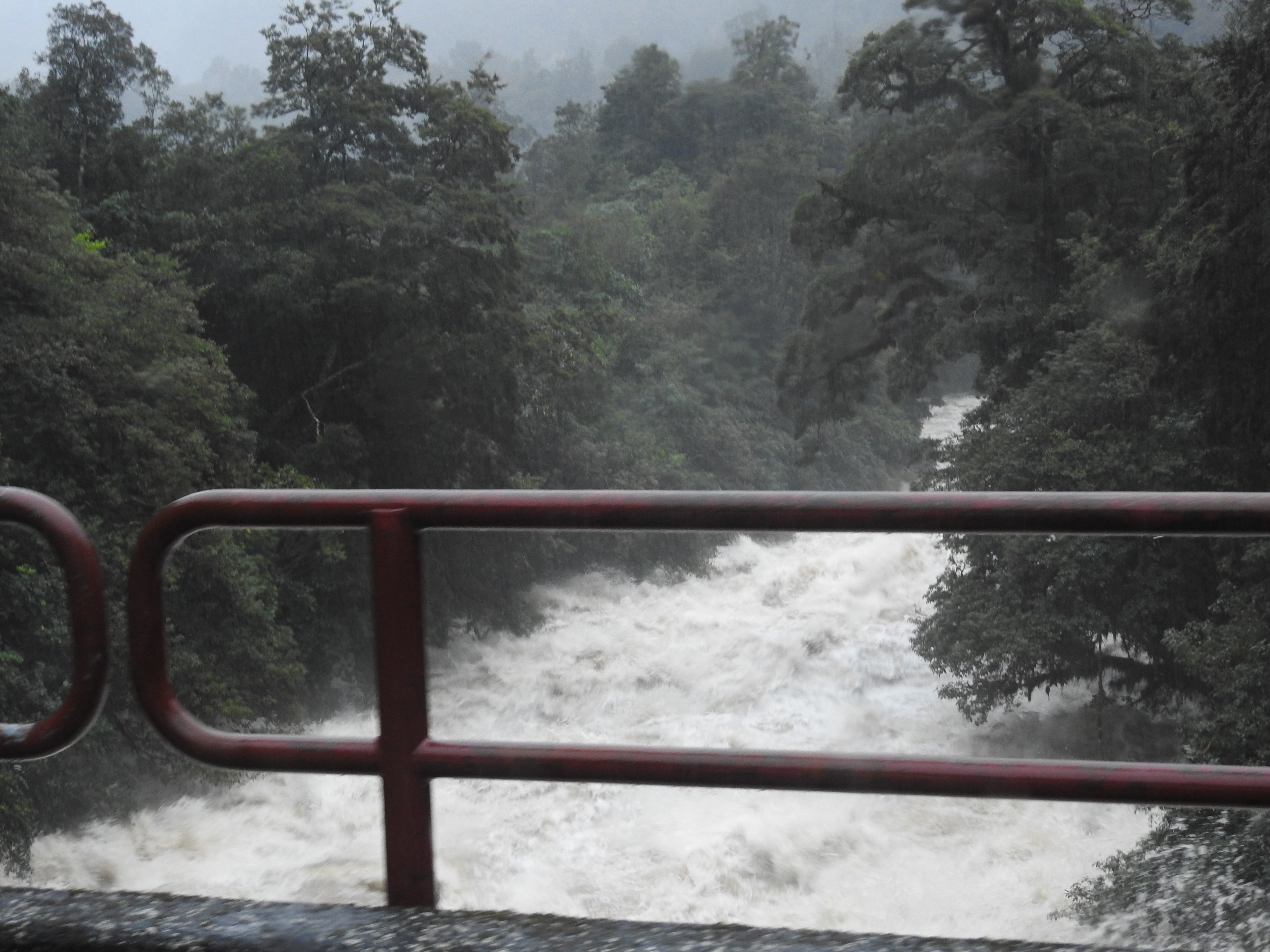
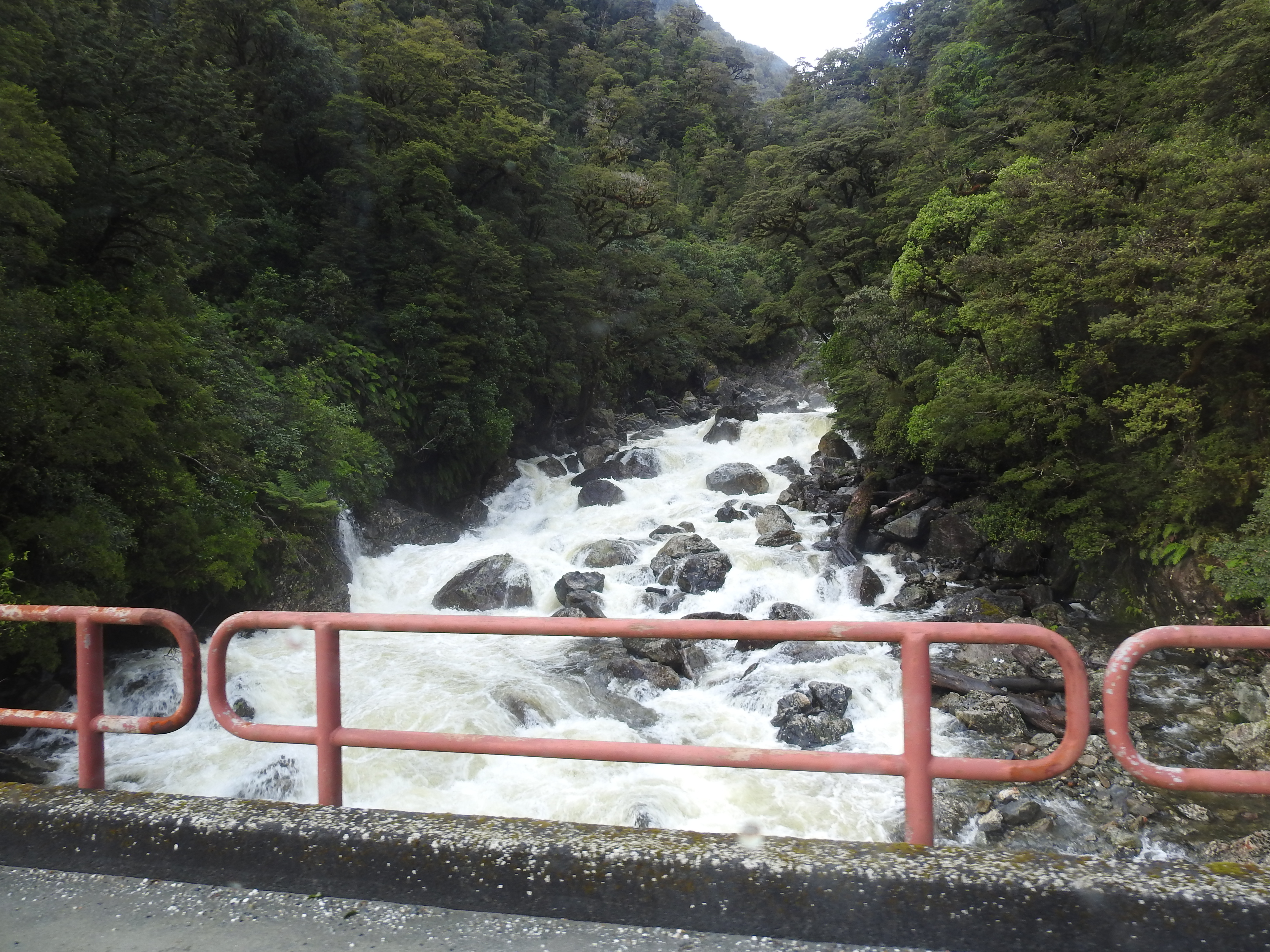
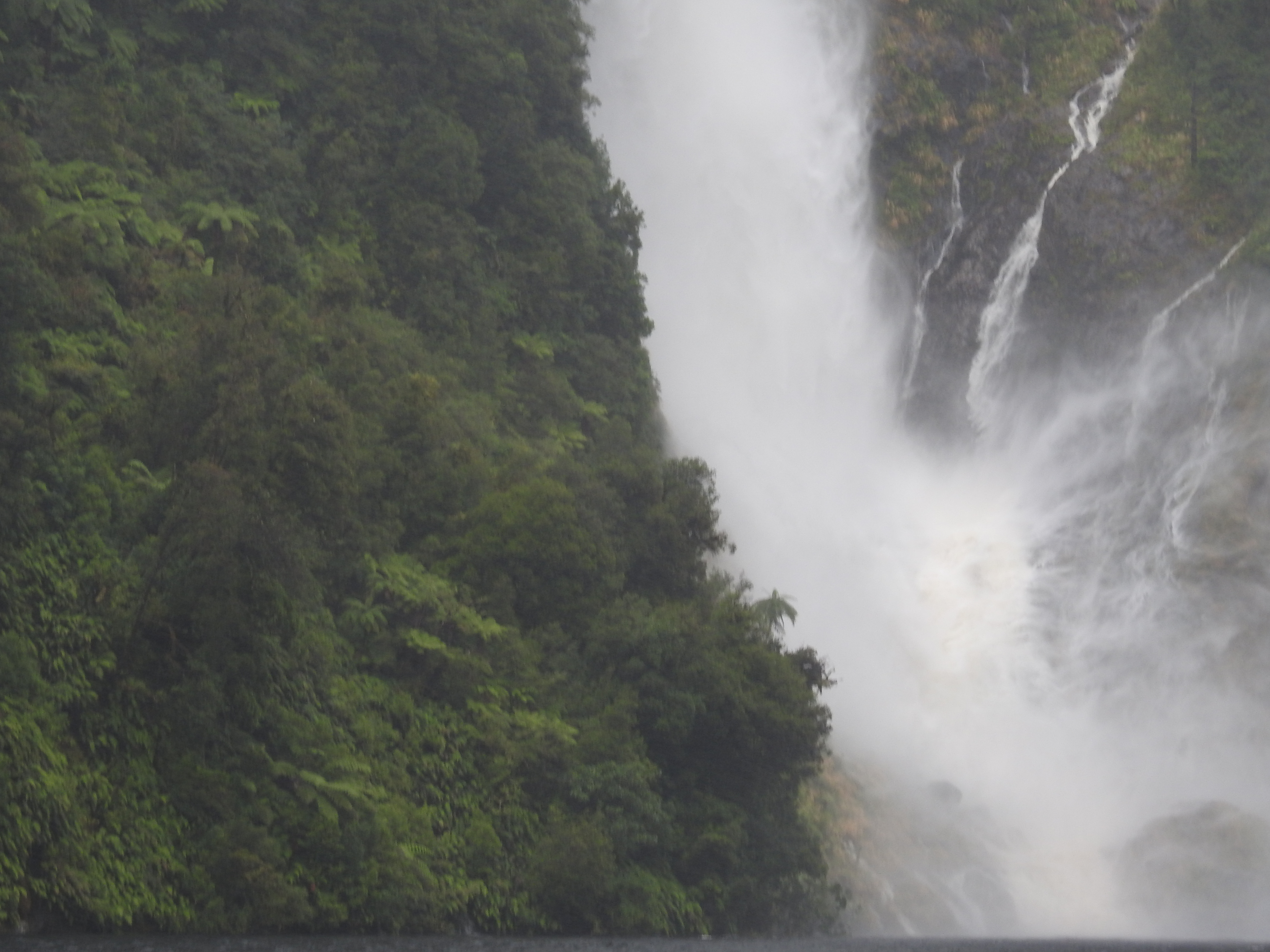
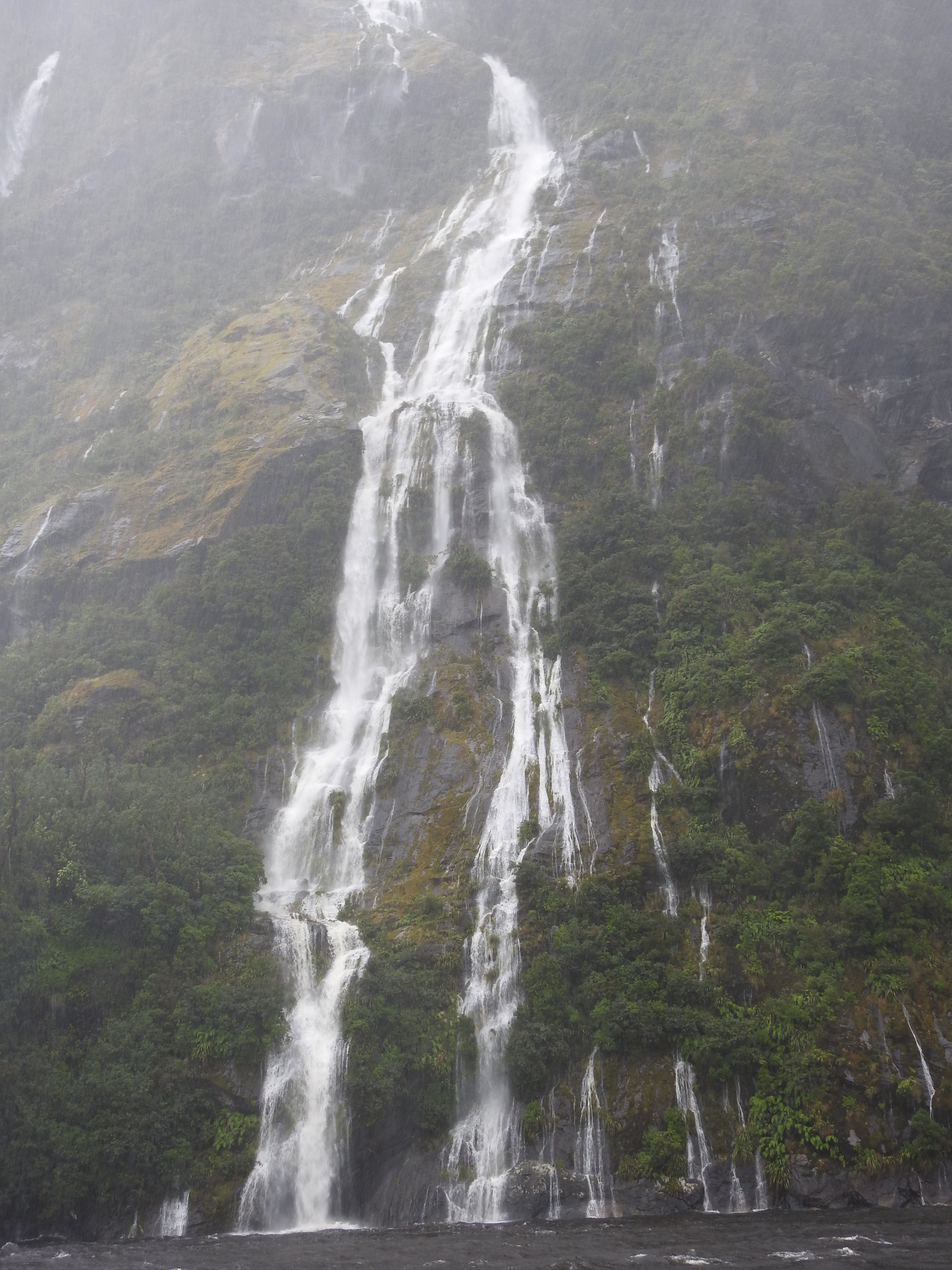
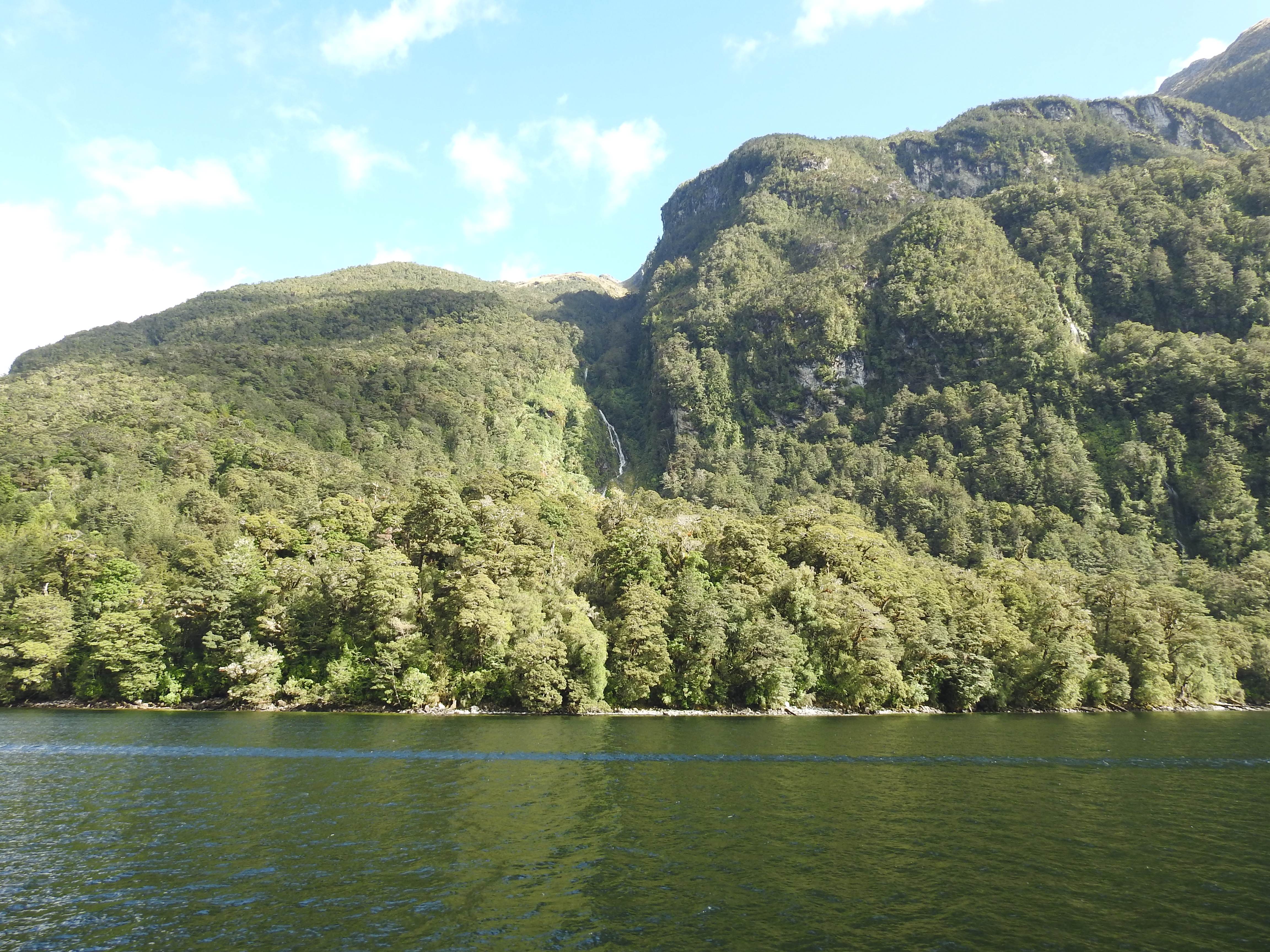
Ten of us were then driven over the pass to Deep Cove. We passed old landslides and could see how they can happen easily, as in places the road was seriously awash. Of the hundreds of waterfalls we passed, only two are permanent. The roadside gullies were full of streaming water. It was hard to believe so much water could fall so quickly!
On the way to Doubtful SoundOn the way back, the next day
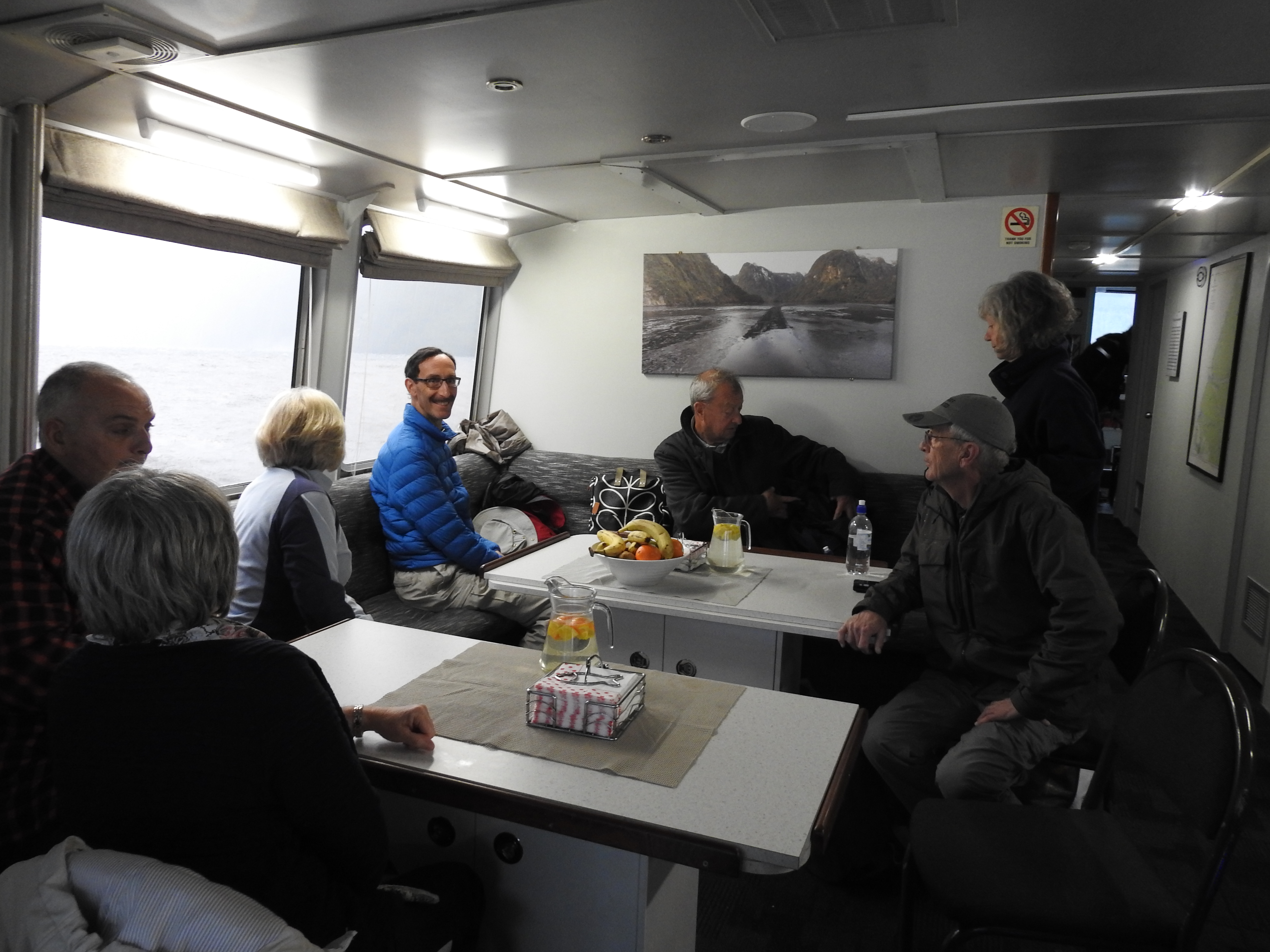
We then boarded the boat for our overnight trip on Doubtful Sound. The rain was torrential and visibility extremely limited but the company (10 passengers and three crew) was very congenial.
On the Fjordland Explorer
There was one Southern crested penguin (which disappeared
before I could focus the camera), two sealions, and a couple of gulls but
otherwise just water – below us, all around us, and cascading down the
mountains. We heard the next day that there had been 225mm of rain in that
24hr!
Wednesday morning was cold and crisp – and rainfree!
Caleb dove for crayfish, aided by Leyla and Lou. Commander Peak 1,890m high was visible on our way back but not on our first day
We returned to Pearl Harbour and Manapouri in increasingly sunny conditions. Lake Manapuri contains 33 islands, more than any other lake in New Zealand.
Day three of The Active Living and the Environment Symposium
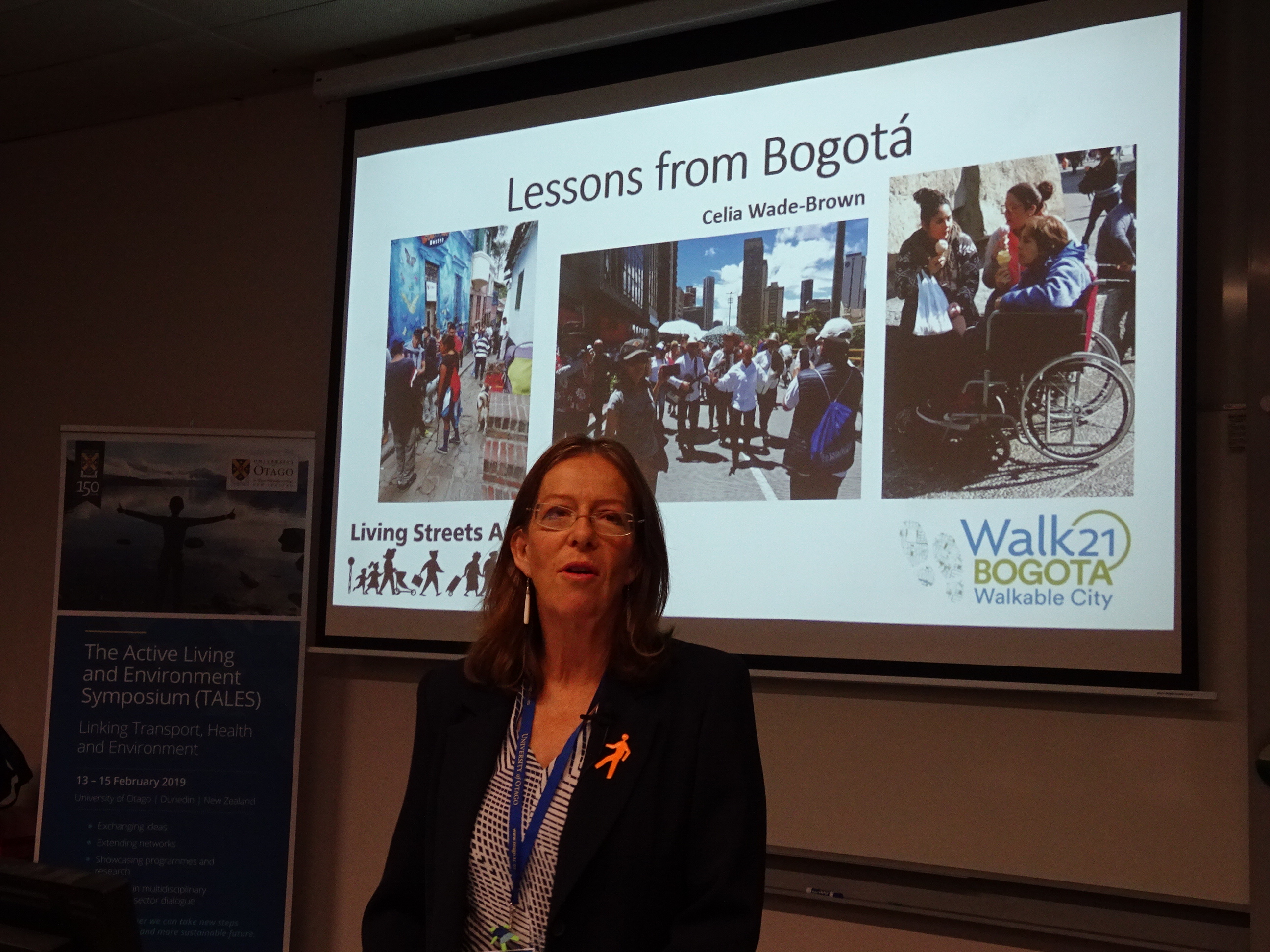
The morning began with another plenary session. Celia Wade-Brown QSO, of Living Streets Aotearoa, reported some of the highlights of the Walk 21 conference that had been held in Bogotá, Colombia. She referred us to the Walk 21 Charter and encouraged us to sign it as individuals or organisations (www.walk21.com/chartersignature).
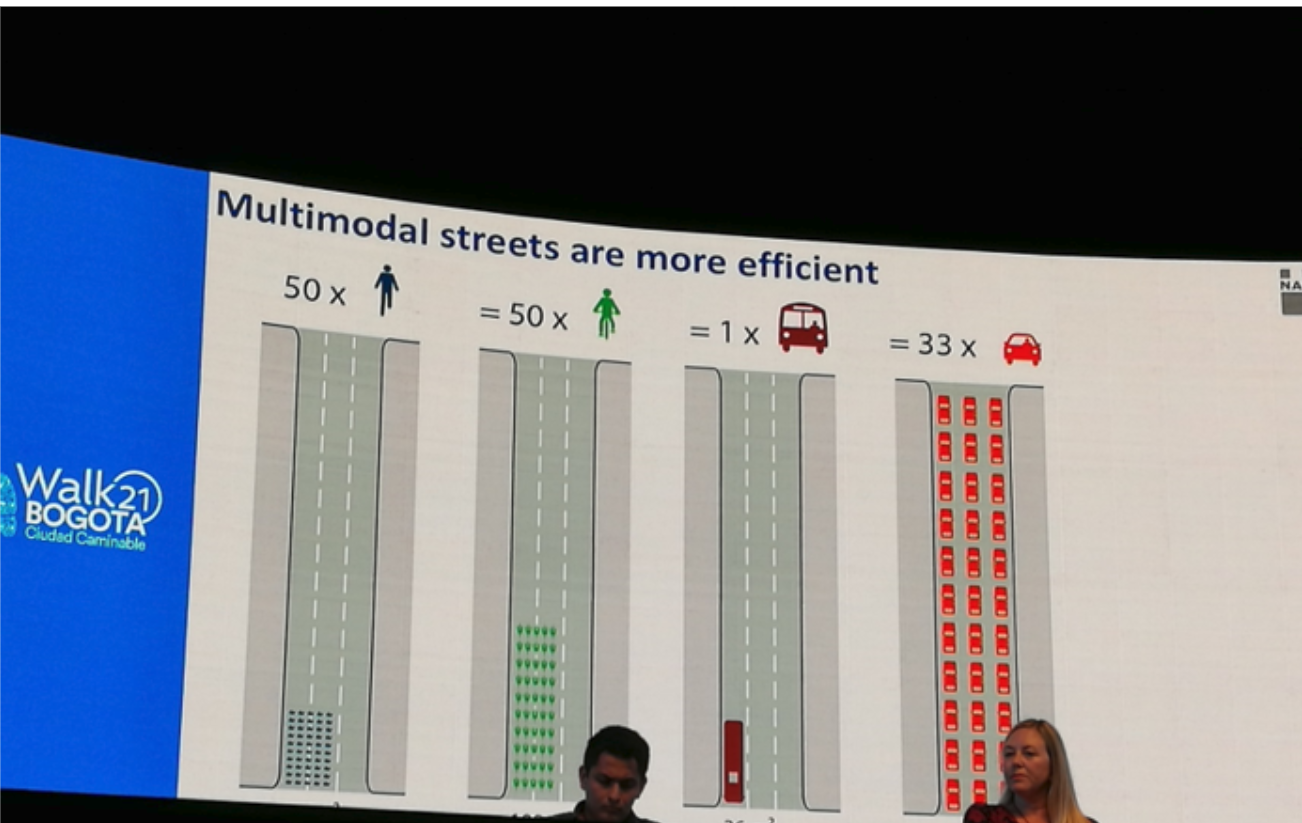
Living Streets Aotearoa was founded in 2001. Its current priorities are lower speeds for vehicle traffic; funding for walking; walking to and from school; and standards for walking infrastructure. Local targets are an important way to ensure adequate funding, and that it is spent appropriately. She said “It’s not just space, it’s movement. Walking is so efficient!” Citing an analysis by NACTO, she pointed out that at maximum capacity, about 8 to 9000 people per hour can walk along a footpath but private vehicles can only shift 600 – 1,600 hour in a lane.
Celia Wade-Brown QSO Driving is an inefficient use of space!
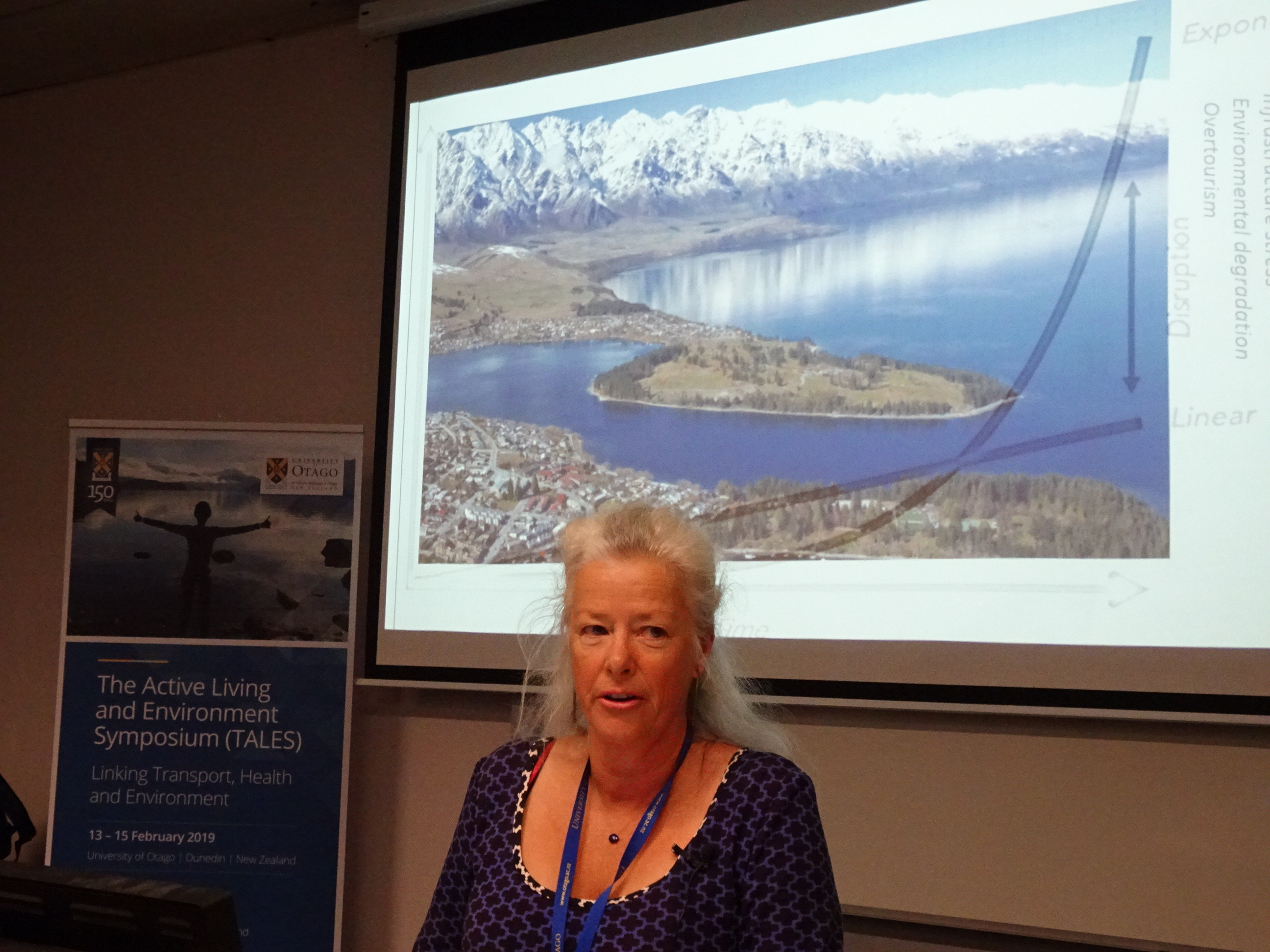
Alexa Forbes, both working at Otago Polytechnic and a local councillor for Queenstown, spoke on Transport, environment and everything in Queenstown. Although Queenstown has only 30,000 residents, there are 2.5 million visitors each year, with 50,000-100,000 people present in the town each day. She described the vicious circle that occurs when people feel the need to be car-dependent through lack of affordable housing within the town and lack of other transport options, leading to more congestion and the adverse effects of cars on people and the environment.
Alexa Forbes
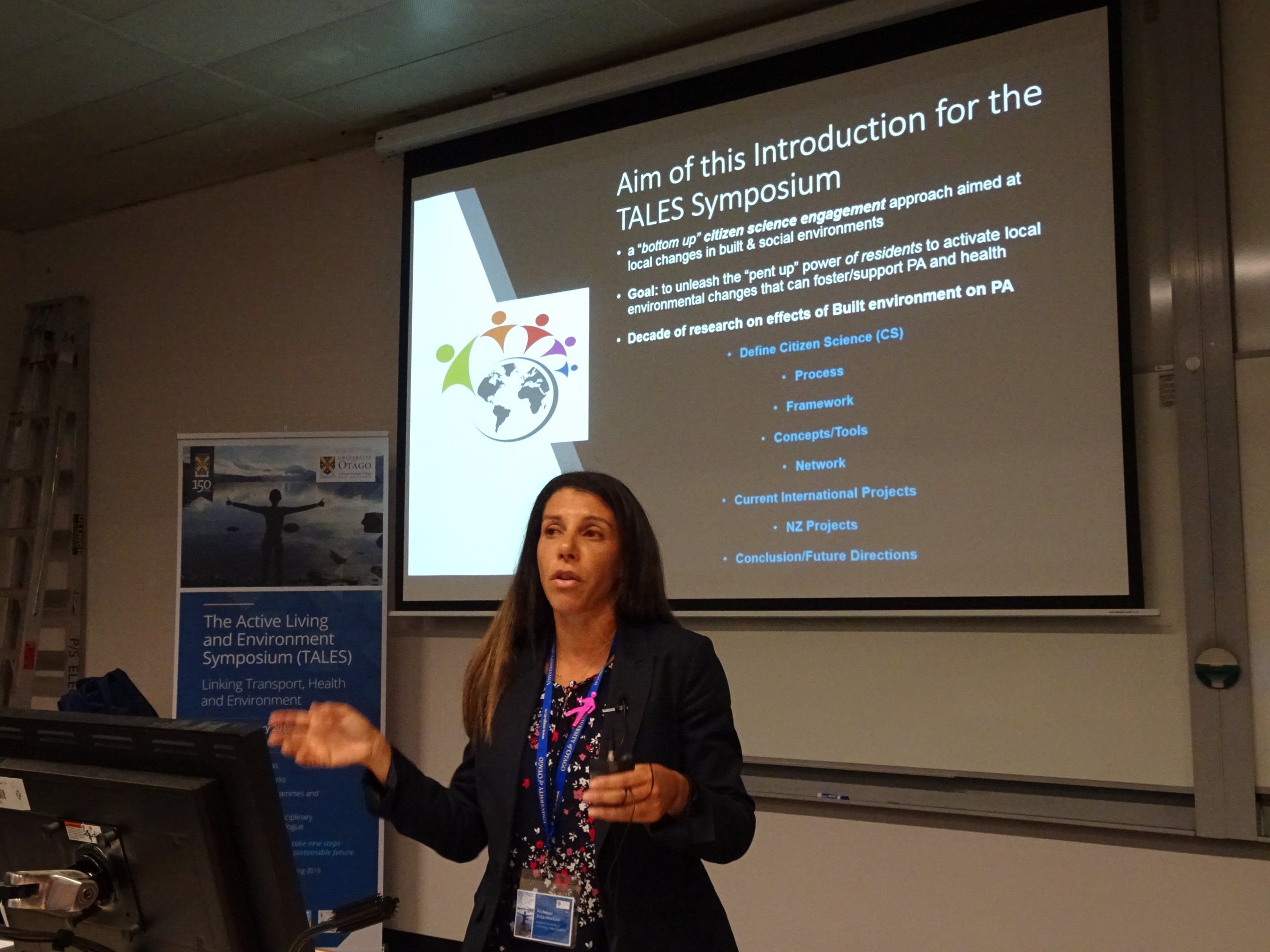
This session ended with a talk by Prof Erica Hinckson, of Auckland University of Technology, on Citizen Science. Research has moved from being done for the people, to being conducted with the people; citizen science moves the research process on another step to being conducted by the people. She recommended the Stanford Healthy Neighbourhood Discovery Tool app.
Prof Erica Hinckson
After another networking refreshment break, the session on Urban Environment started with a remote presentation by Prof Shanthi Ameratunga from the University of Auckland, with colleagues from Massey University and Stantec Ltd. She pointed out that privilege matters. There are effects of power and of affluence on mobility and health. The oldest and healthiest participants in their Inclusive Streetscapes Project lived in the most affluent case study area. The researchers found that people with high levels of education, computer literacy, and understanding of systems were able to navigate public transport systems even if they used such travel modes only occasionally. However, those with less social power relied on family as an important source of support for their travel needs. Petrol costs and bus fares were challenging, as were obtaining usable information on routes and timetables.
Lutfur Rahman arrived and started his PhD programme at the
University of Otago the day before the TALES symposium and presented his PhD
proposal on his fourth day in New Zealand, which was very impressive! He plans
to use BEATS
Study data to model objective and subjective aspects of the built environment
that are associated with walking and cycling to secondary schools in Dunedin.
Data from the BEATS Study were also used by Tessa Pocock and co-authors, which
found that adolescents’ perceptions of walking safety was the strongest
correlate of active travel to school but other objective measures of the school
neighbourhood environment were not significant predictors of active commuting
to school. The session closed with a presentation about the Climate Safe House,
working with a vulnerable homeowner to provide a warm, sae, efficient, and
transportable eco-home that can be moved to a safer location if, for example,
water levels rise.
The parallel session examined e-bikes and sustainability.
Matt Shipman, of Greater Wellington Regional Council, has been providing
training through the Pedal Ready Cycle Skills Programme. Matthew Jenkins
reported on the experience of electric bike users in Dunedin. Their data, from
a focus group, highlighted a number of positive and negative aspects of e-bike
use, both personally for users and in the attitudes of other road users.
Sue Smith spoke about the five-week series Bike with Us,
part of a Green Prescription programme in Napier and Hastings. Participants
were taught to cycle on traffic-free routes. Bike with Us programme has now set
up two regular cycling groups and five participants trained to become ride
leaders. New friendships are important in providing support to build confidence
and motivate each other to continue participating. Shannon McNatty told the
audience about Education Outside the Classroom (EOTC) and how they had taught
11- and 12-year-olds through educational active travel trips once a week for
six months, covering environmental, social, and physical learning objectives.
In addition to increasing experiential learning and increasing physical
activity levels, the programme encouraged new friendships, developed
self-esteem, and enabled the students to support each other.
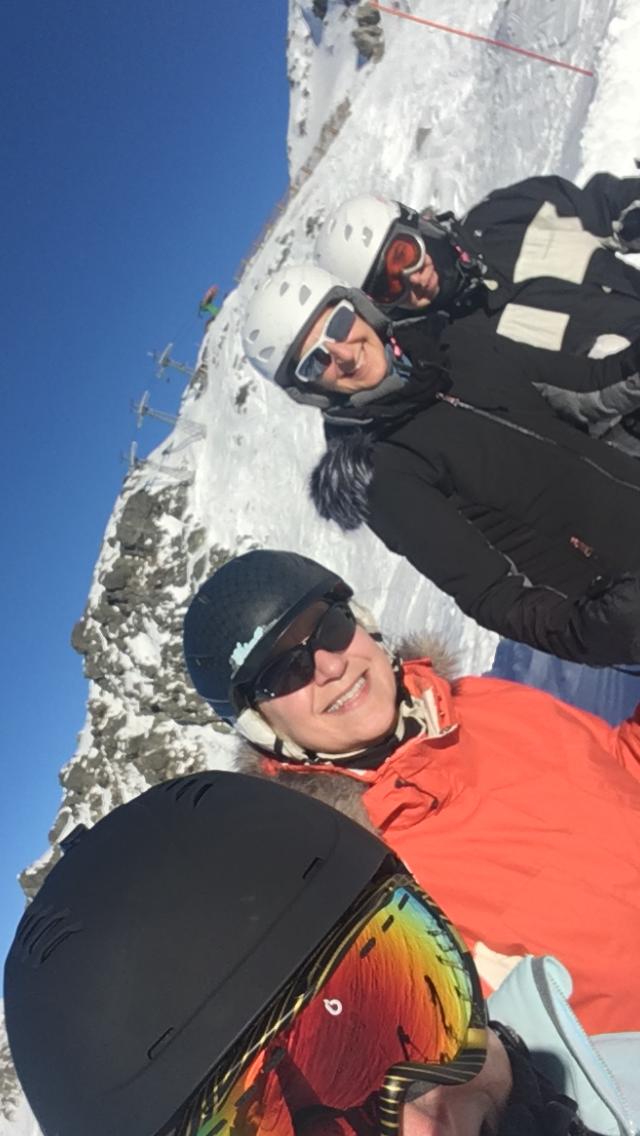
The importance of other people’s attitudes was highlighted to me last December, when four female friends, who usually ski with their husbands and children, shared a skiing lesson. They returned enthused, reporting that the two hours was filled with encouragement, support, and praise in place of the “come on, you’re keeping us waiting” that they were accustomed to.
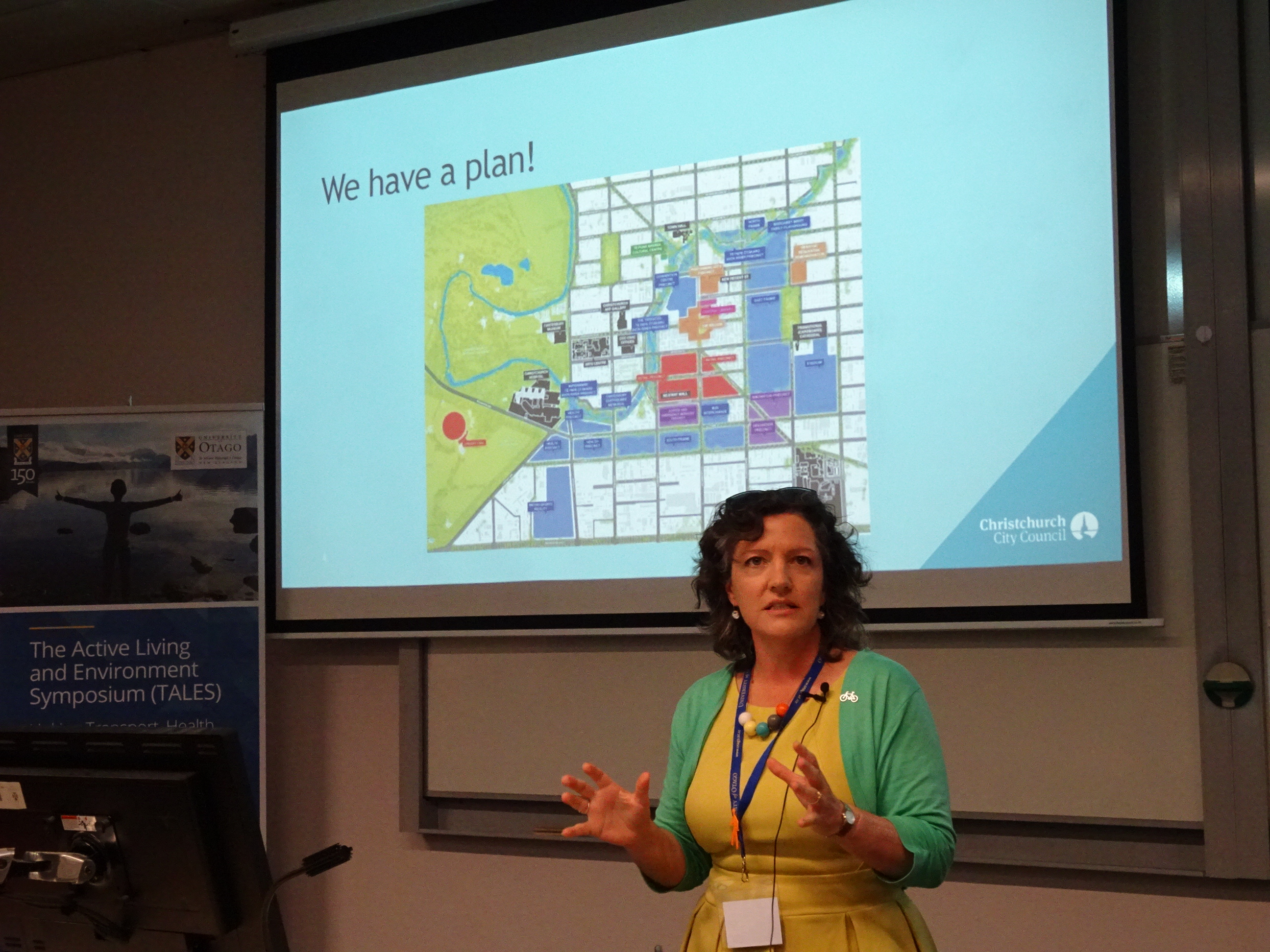
After lunch, Sara Templeton, a councillor for Christchurch City Council, spoke on the difficulties in moving towards a sustainable 21st century city. It takes time to consult and build the necessary infrastructure but many people oppose change, adding to the time it takes for behaviours to change. She gave examples of what is sometimes termed in public health ‘management by decibels’, where those who complain the loudest may be listened to more even if they are not representing the majority views. She presented factors that influence decision-makers at the political level and encouraged planners, designers, advocates, and experts to engage with politicians.
Sara Templeton
She told us that their ‘Share an idea’ project had results in more than 100,000 ideas! Christchurch has a legal requirement to institute a 30km/h zone in the central city, and then engaged on extending it as the city developed differently to what had been expected. Their surveys of people cycling have found hat 94% of people feel safer cycling on a cycleway (rather than on the general road). Of people surveyed when cycling:
50% were cycling to work;
others were doing things that we might do in a day ie shopping, recreation;
40% were female;
15% would have used a car for that journey before the cycleways were built; and
43% would still have cycled but would have used a different route.
To end that session, the TALES participants were given a presentation about the key policy recommendations by members of the working group, followed by discussion with all those present on both the broad concepts and some specifics. The recommendations have now been finalised and the document is being prepared for publication in April or May. Watch this (and other) space(s)!
After our 5 mile walk Saturday morning, to watch the pipe bands marching down George Street, then my 4 mile walk in the afternoon to watch the top bands performing in the national contest, we had an even more energetic Sunday. We had carefully moved our watches back an hour – but discovered later in the day that NZ winter time doesn’t start for another week. So for the next 7d we are 12h ahead of the UK, before reducing to 11h. Very confusing!
We spent the morning cycling to, and then up, ‘The Big Easy’, a 6km zig-zag trail up Sentinel Hill that gains 290m elevation. There was some evidence en route that not everyone made it up and back down again safely!
By the time I reached the top, there was nothing to see except cloud and mist.
Luckily, I took photos at Sentinel Plateau, two-thirds of the way up.
View from Sentinel Plateau before the clouds descended
David went down the way we had come but I opted for the main
road, which was a glorious, downhill road with gentle curves.
After lunch, we went out again, first to the botanic garden.
Alpine rock garden
Then we went to watch birds down by Otago Harbour.
Royal spoonbills, Little black shag, Pied shag, Skua & white-fronted heron